
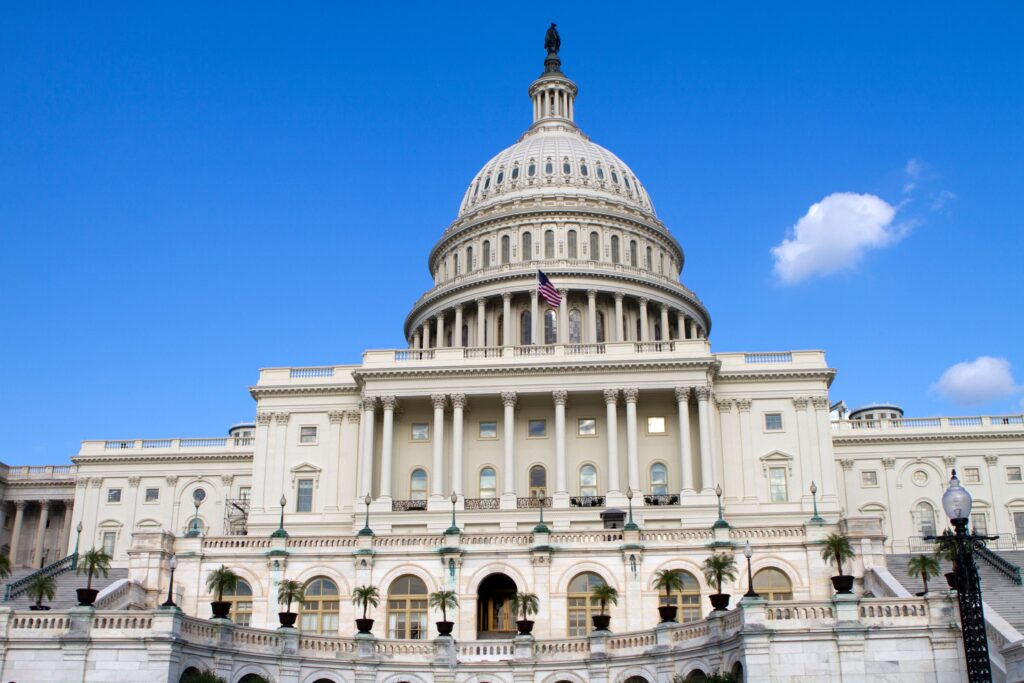
The 2026 midterms election flipped both the house and the senate in favor of the Democrats in what has been coined a “Blue Tsunami” by NBC news. Alexios Alexander, the program director of political science at Eastern University, helps break down what this historic turnaround means for the students at Eastern.
“The scale of the midterm elections victory for the Democrats was beyond almost anyone’s expectations,” Alexander said. “It’s a generational result, where you have [democratic candidates] winning, not just in the House of representatives or in the Senate, but governor’s races, state legislature races, in red states.”
Alexander compared the shift to a “climate change, world-ending level tsunami.”
Alexander theorizes the blue wave is due to “the Republican president, who promised to lower prices and make people’s lives more affordable, and not to get into wars, and then everyone realized there was an unjust war, plus growing awareness over the genocide in Gaza and the injustice of that.” Trump not delivering on his campaign promises is just some of the reasons why voters flipped their vote.
Yet, democratic policies are not quite veto-proof. To be veto-proof, a policy needs 67 votes, while currently the Democrats have 56 seats. With Republican Donald Trump as president, Alexander speculated that “he’s gonna have to decide whether he’s gonna be Mr. Veto.” He then said, “If Trump vetoes things, then the Democrats can basically hang that around his neck and say, ‘look who’s the obstacle to helping improve your lives.’”
This Democratic majority means that many bills for funding of higher education institutions, like Eastern University, have a better chance of being increased, or at least stabilized. “Potentially the Trump administration is gonna be a little bit less brazen in its attacks on higher education, given the results,” Alexander said.
The policies accepted and vetoed in the Senate and House in the next year will have “a lot of influence on the presidential race,” according to Alexander.
Josh Shapiro, the incumbent candidate for Pennsylvania’s governor, was called within minutes of polls closing due to the volume of mail-in ballots. This win, in addition to winning majorities in both chambers of the General Assembly means that Pennsylvania has achieved the “Democratic Trifecta” that Shapiro was aiming for.
“A lot of bills that the Democrats and the Pa. House have passed and gone to the Senate of Pa. to die. Literally thousands of bills in recent years,” Alexander said. “It’s essentially been a non-functional state-level government.”
Now, with the democratic trifecta, the bills that Shapiro has been campaigning for, such as raising the Pennsylvania minimum wage and increasing funding for public transportation, have a chance to pass into legislation.
Youth voters showed out, with 27% of 18-29-year-olds going to the polls during the November midterms, which is the second highest youth voter turnout in a midterm in the past 30 years.
Senior math major, Vesa Pema, said “I feel like a lot of my rights have been threatened with Trump’s presidency.” Pema continued, “I was just voting for somebody that’s gonna fight for my rights in some way.”
“I woke up [after election day] and I clicked my heels, genuinely. Like, I was so happy,” Pema said. She pointed to the Senate flipping seven seats to the Democrats as evidence, “If that doesn’t tell you that nobody likes what’s been happening. I don’t know what does.”
Alexander said, “One of the dangers in a democracy is that if people are apathetic or feel like it’s not possible to change things, then that really allows injustice to continue, and that really allows the status quo to be unchanged.” He pointed toward the amount of youth turnout as evidence for the “social transformation” in the way citizens chose to vote in this election.
