
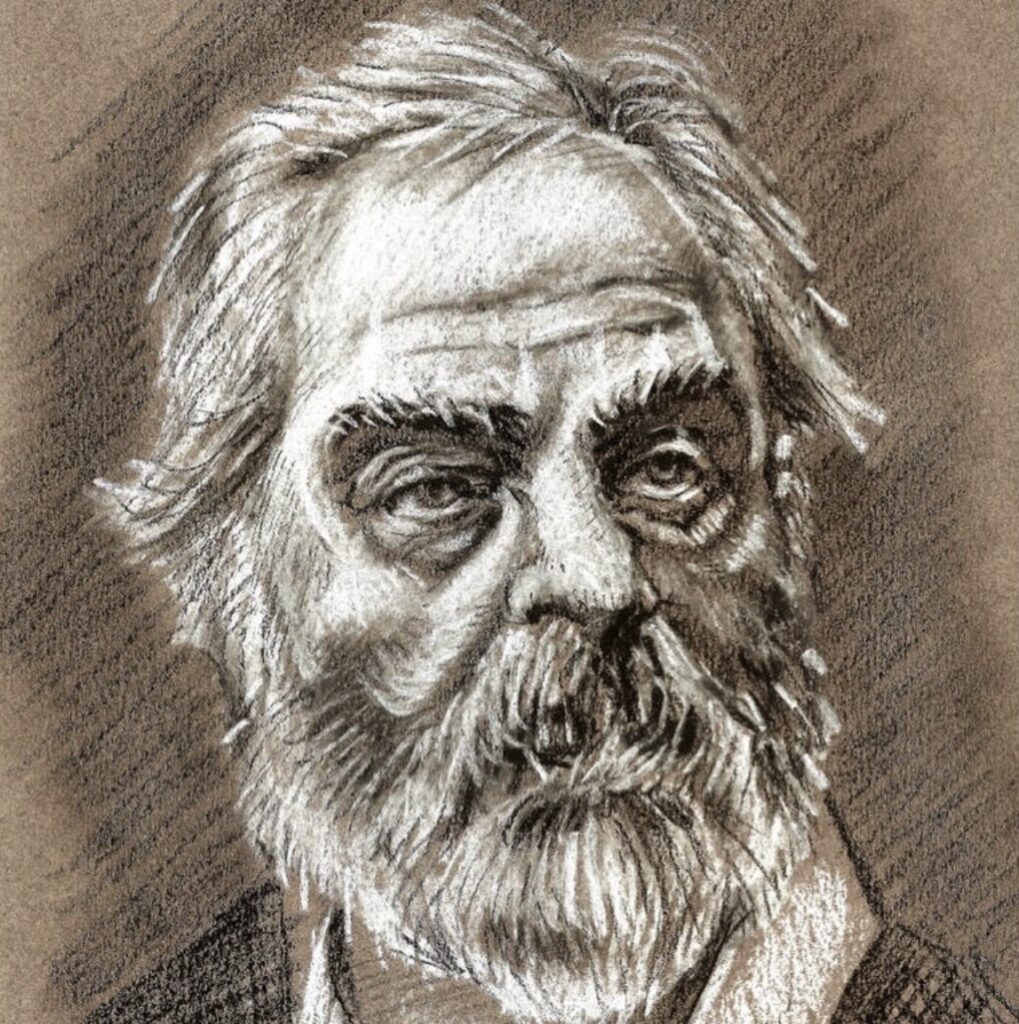
Many talented artists reside in the greater Philadelphia area, but one named Jerry McHugh is particularly a master of his craft. This lover of old photographs and maps, history, music and strange stories uses his adoration of the past to breathe life into his charcoal pieces.
McHugh was raised in Philadelphia, Pennsylvania, but currently lives in West Chester. His early life involves a formative culture of art, as he claims that, “my mother was very much focused on the creative, illustrative and emotional aspects of life while my father was considerably more practical, facts and figures.” When contemplating his influences, McHugh believes that he “benefited from experiencing those extremes growing up, different social circles, politics, spirituality, interests, pretty much entirely opposite ends of the spectrum.”
One particularly formative memory for McHugh was one of his first “real” commitments to art. He says that, “when I was 15, I think I stayed up all night, eight hours straight listening to Ozzy Osbourne’s Mr. Crowley as I recreated a Gustave Doré line illustration of the ninth Circle of Hell from Dante’s Inferno … It’s equally hopeful and awful. But it was enough to give me inspiration that would last me the rest of my life.” At this point, McHugh was a boy who loved to draw, which is a love that he has never grown far from. He would practice through requests from peers in various mediums.
He enrolled in art school for three semesters during the transitional period from high school to adult life, and explains that the work was not as challenging as he had hoped. As is a common experience of young creatives, McHugh states that, “I had no idea what I wanted to do with my life.” When commenting on the nature of art as a virtue and professional field, he explains that he has “tremendous respect and envy for those brave enough to see it all the way through.”
McHugh explains that his first influences in the “academic” art sense include Renaissance masters. Soon after, he became enthralled with notable names like Van Gogh, Toulouse-Lautrec, Charles Dana Gibson and John-Singer Sargent.
McHugh soon transitioned from his artistic studies to that of computer science. He says that this “actually wasn’t as much of a departure … Staring at a blank canvas isn’t all that different from staring at a blank IDE trying to write code.” With this as his new area of expertise, he could begin to use art as an element of his life that did not assume monetary gain. “I rarely charge for my work, unless it’s a commission or something substantial,” McHugh said.
Regarding McHugh’s artistic process, there is a certain level of nostalgia that drives his creation. He says, “I don’t necessarily consider myself melancholic though. I appreciate atmosphere and interpretation, but I also think the art world gets carried away trying to assign profound meaning to everything.”
To him, inspiration springs from an emotion or a scene. McHugh says, “I think sometimes I’m more interested in what happened five minutes before the scene or what’s going to happen five minutes afterward than the actual scene itself.”
A creative process involves the invention and projection of the self into that of his subject matter. With charcoal, McHugh can transpose a fleeting idea onto the paper. He explains that art allows him to “start noticing expressions, lighting, posture or how an otherwise ordinary scene can become interesting depending on how it is looked at.”
When asked about what advice artists should hear, McHugh responded by saying that anatomy, perspective, composition and light are all essential aspects of study. Additionally, he emphasizes the importance of not getting caught up in having a creative identity. To McHugh, what matters is to “stop explaining what your art represents and actually make the thing.”
He encourages artists to “Study artists you admire, borrow ideas, experiment, make mistakes and eventually you’ll develop your own preferences. I wouldn’t get too caught up in trying to manufacture a particular style at the start. You’ll probably develop one whether you intend to or not.”
For him, art is relational in a way. He says, “I suppose part of what interests me is what you don’t know about somebody. What happened to them before you saw them, what they’re thinking about, what they’re going home to. You can invent an entire life for somebody based on a single expression, it’s interesting to think about. Sometimes one drawing isn’t really enough for the idea either. I’ll start thinking about a particular scene and before long I’ve imagined two or three others that could go along with it, almost like some elaborate storyboard nobody asked me to make.” In a way, McHugh uses his art as a vessel of human expression and narrative structure and continues to do so through varying mediums.
