
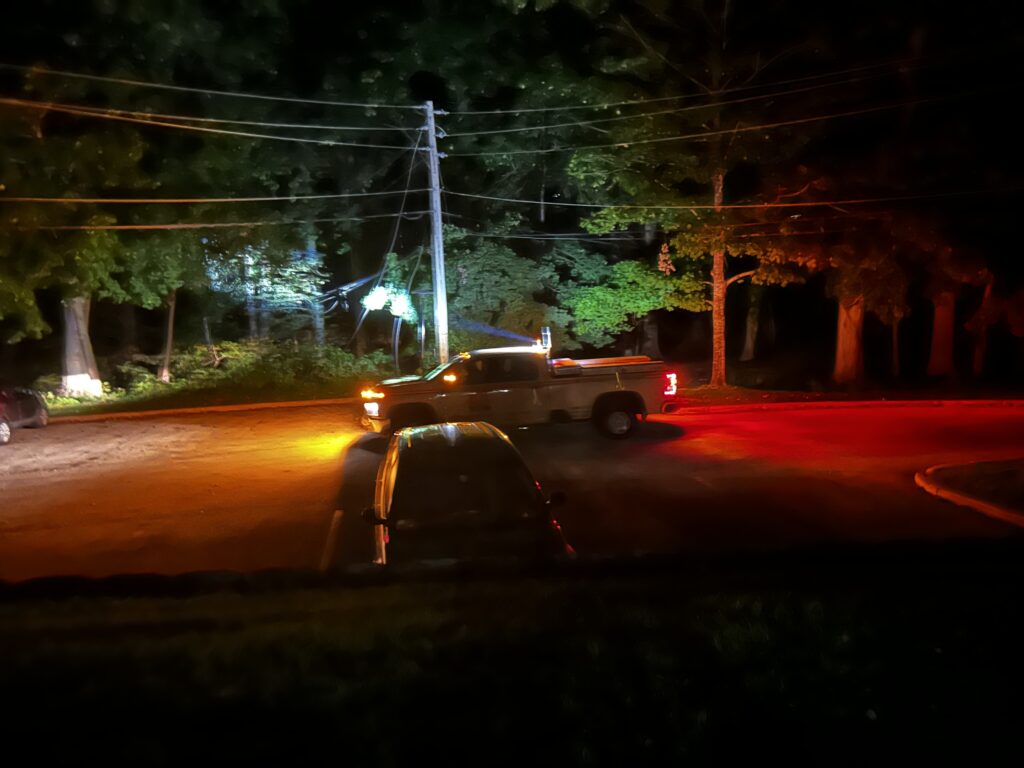
Everyone on Eastern’s campus, no matter the dorm, hall or building, has been impacted by at least one power outage during just the first month of this fall semester. Power outages in this area are common; however, having so many occur in such a short period of time is very unusual. Thus far in the semester, plant operations have sent out emails about power outages Aug. 25, Sept. 7, 8, 9, 10, 17, 27 and Oct. 5. Furthermore, the power has flickered consistently during fall storms, which have been unusually intense. Power has even taken over a day to be restored, which has disrupted dorm life and classes.
In an interview with the director of Public Safety, Michael Bicking, and the executive director of Plant Operations, Steven Hartner, they discussed the power outages, their cause and how they are being managed.
Hartner said, “When an outage originates on our end, roughly 95% of the time it’s tree-related—either branches snapping or entire trees falling across power lines. The other 5% are planned shutdowns we schedule ourselves for preventative maintenance. That said, our internal grid only accounts for about 15% of the total outages Eastern sees; the remaining 85% are external issues directly tied to PECO.” The tree does not even have to be on Eastern’s campus to cause an outage on our campus.
Trees falling on Cabrini’s campus caused several power outages; even a tree falling on a construction site up the street caused an outage in September. Bicking said that having above-ground power lines is another reason these outages keep happening. Bicking said, “Where I live out in Chester County, where most of the county, any new building… typically has underground power. That keeps you from losing power when a tree goes down. And we have a lot of old trees here.”
On Sept. 27, a few students actually saw a power outage occur by the tennis courts. David Gonzalez, a student who witnessed the event, said, “We see the sky light up for about three seconds; we look, the sky goes dark, all the power goes out and you just see a blue spear turning green, blue and white.”
It is undeniable that the power outages have inconvenienced students, adding difficulty to their lives when they need regularity and consistency. Hartner said, “We recognize how disruptive outages are to your daily routines, and Plant Operations stays in continuous communication with Student Development to keep improving conditions for everyone. Because every outage scenario is unique, the Student Development team is the best resource for day-to-day advice on how students can navigate campus life and stay supported during these moments.”
Plant operations have implemented short-term fixes but are also in the process of offering long-term solutions. Hartner said: “Reliable power distribution across Eastern is a huge priority for us. Over the Fall Free Days, we cleared trees in the ‘North Woods,’ which was our second major preventative project this year, with more on the way. At the same time, we have officially kicked off phase one of a campus-wide effort to upgrade our backup generators, taking a phased approach to ensure our power supply is much more resilient.”
Many students were confused as to why the emergency messaging systems were not being used. When answering this question, both Hartner and Bicking mentioned that the purpose of the alert system is intended to be used for more urgent emergencies. Hartner said, “The emergency alert system is run through Public Safety and Student Development to push urgent notices across campus. While Plant Operations sends out email updates, we’re actively working on bringing the emergency messaging system into the mix as well for outage communications.” Bicking said, “They (the emergency messaging systems) have to be really short and concise. They have a word limit… I believe they’ve found that emails are more desirable to the students and the population of the campus because it can be detailed.”
