Eastern’s Theatre Department provides many opportunities to witness the world of theatre throughout a semester. This fall, their mainstage production is a performance of Oscar Wilde’s “The Importance of Being Earnest.” Wilde wrote “Earnest” back in 1894, as a farcical mockery of the hypocritical Victorian elite. The play is witty and full of subtext and double meanings. (Take a second look at the title, for example.)
However, although the play was written more than a century ago, the play’s comedy and themes of identity still apply today. Valerie Flower, who directed the show, said that she not only hopes the audience “leave[s] laughing,” but also: “I hope someone on the walk back says, ‘Wait, which version of me do I actually want people to meet?’”
The cast ranges from Richie Izzo, an alumnus who returned to Eastern’s theatre department for this play, to Stefany Sastre, a transfer from Valley Forge University who is studying abroad from Columbia.
Alexander Morales, who played Jack Worthing, shared over email that the cast “truly feel[s] like a family, and the chemistry we share outside of McInnis Theatre translates so beautifully onto the stage.” He explains that “so much of the comedy comes from the chemistry and dynamics.”
Neila Hamilton, who played Cecily Cardew, echoed this, saying that the cast helped interpret antiquated and layered dialogue through the “physicality aspect, the demeanor of each character” and the “character connection.”
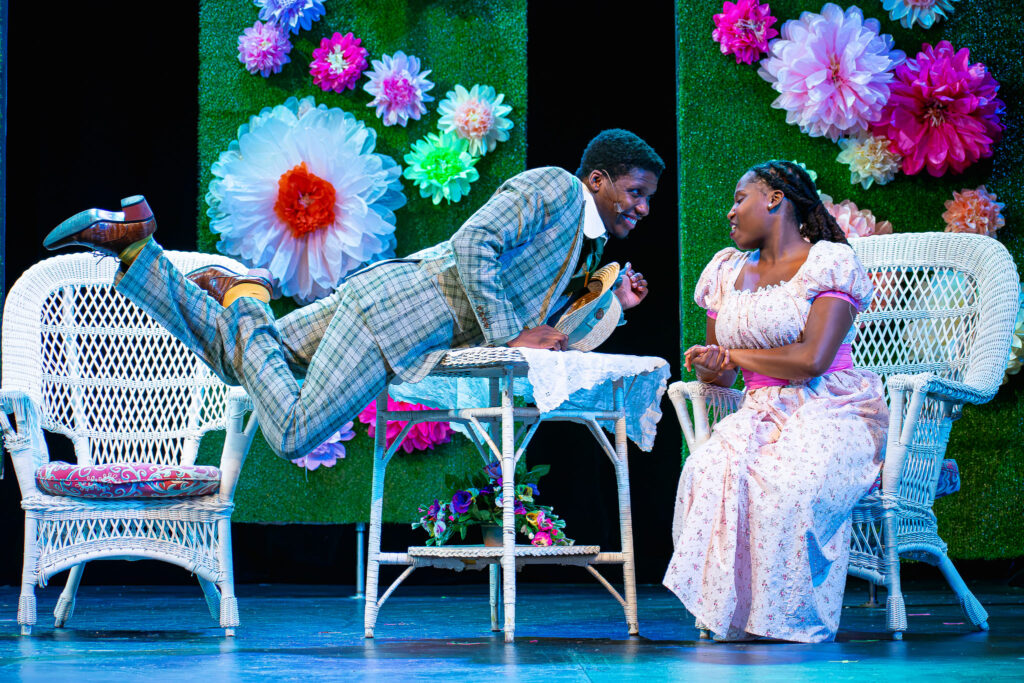
Act II stands out as a special highlight of the acting. Marc Cadet and Hamilton pull off some hilarious chemistry together, as do Hamilton and Libi Martinez. Morales had one of his funniest scenes while mourning a pretend death, while featured actors like Sastre got to execute some silly gags.
Another highlight was Bleu the dog, who appeared in Act I. Flower described Bleu as “a bit of a diva… He tends to steal the scene, but he is beloved by all cast members, even though he insisted on his own dressing room.”
Wilde sets a high bar for performers of his work, so although the cast does a good job bringing his words, the dialogue has potential for even more eclectic humor.
Eastern made one big adjustment to Wilde’s original script, by switching the location and time period of the plot. The play now takes place in 1913, in Philadelphia in Act I, and in the Walton estate in St. David’s in Act II and Act III!
This change manifests itself in a few adjustments to the dialogue and mannerisms. For example, in the 1910s, posh Americans adopted a bastardized British accent dubbed the Trans-Atlantic dialect.
Unfortunately, the cast all attempt this dialect, which does not do any favors at making Oscar’s dialogue accessible – especially when Algernon is speaking through a mouthful of cucumber sandwich.
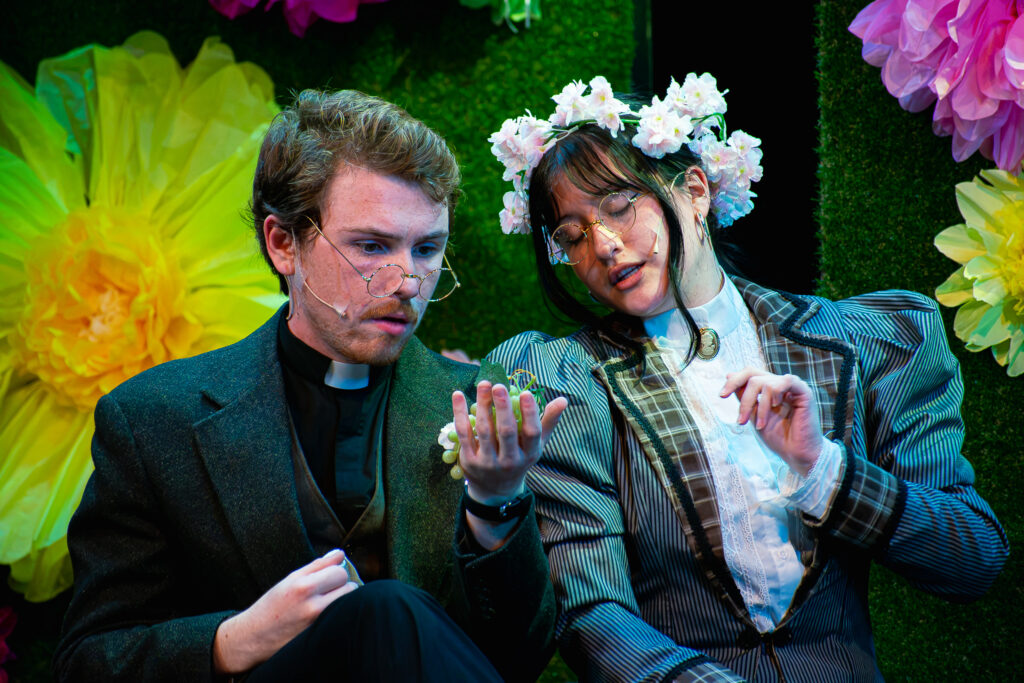
In spite of the time change, the costumes and sets are not consistent to a single time period. However, the set pieces and costumes do help to tell a story about the characters.
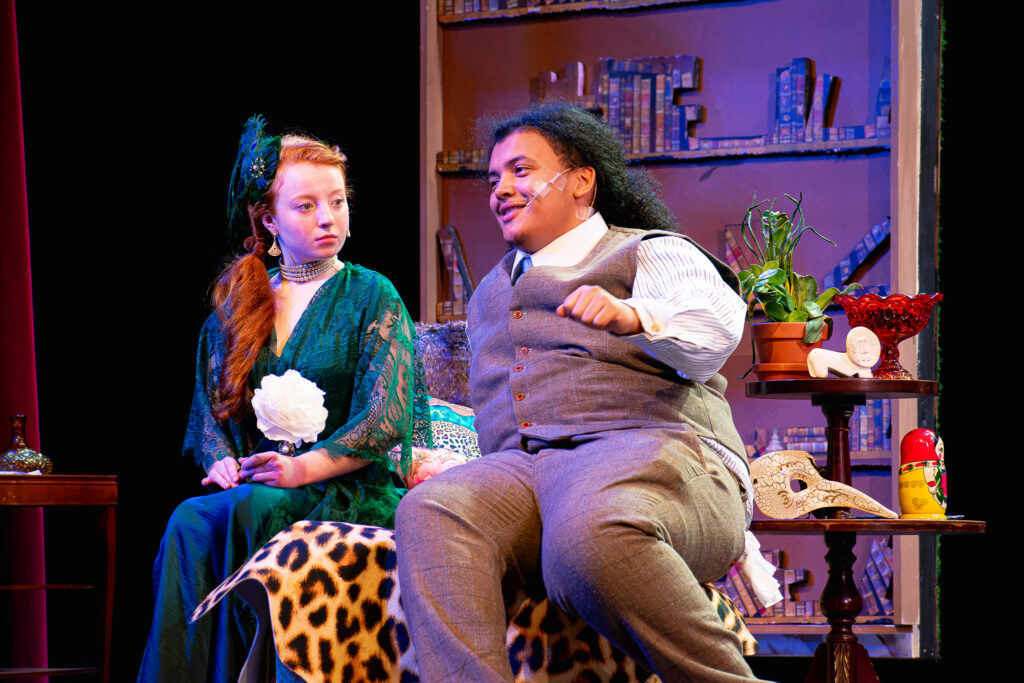
For example, Algernon’s apartments are filled with books, pink, and animal print, reflecting his bold and eclectic character. On the other hand, Act II’s set reflects Cecily’s, with lots of white for innocence and flowers for girlishness – without abandoning the penchant for extravagance that Cecily shares with Algeneon.
Barring their unfortunate resemblance to tombstones, the set pieces generally fulfill their purpose to be a colorful, moveable, story-telling background.
Another interesting choice meant to set the tone was the dance numbers at the beginning and the end. For the opening and for curtain call, the cast engage in what is meant to be a snappy little number set to “Bad Boy Good Man.”
Like some of the other creative choices, the dance does not exactly add very much to the performance, and makes for a rather off-beat introduction to the play. Like the adopted accents, the dance is not quite coherent.
A lot of thought has gone behind each of the creative choices of the play, even if not every choice fully delivers. Overall, the play succeeds in bringing an old play to a contemporary audience, and the cast admirably brings Wilde’s wit and farce to Eastern’s stage.