
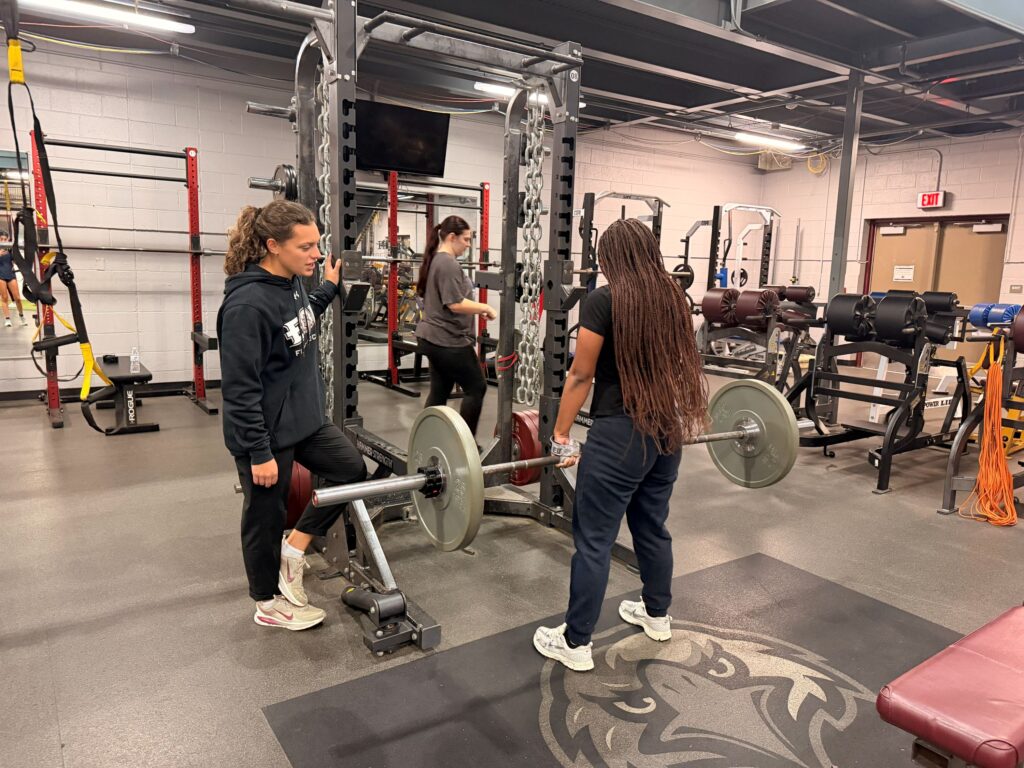
Eastern University has a sweeping range of sports teams with a diverse range of talented athletes. These athletes play all kinds of sports, ranging from field hockey and football to esports and golf. These athletes are hardworking and skilled, and it takes plenty of time, effort and coaching for them to be the best that they can be. Eastern’s strength coaches work specifically with these athletes to help them be stronger, faster and more resilient, whatever their sport may be.
Ross Weyandt is the assistant athletic director of high performance and external operations and has been in this role for about eight months. This job certainly involves coaching, but also involves a great deal of coordination, teamwork, time management and organization that goes on behind the scenes of the athletic events themselves. Meredith Marstellar is an assistant strength and conditioning coach and is currently working toward her master’s degree in organizational management at Eastern alongside working as a strength coach.
While they were both very busy getting everything together for the homecoming games this past week, Weyandt and Marstellar took some time to talk about their education, roles on campus and what they strive to accomplish in their vocations.
These coaches’ jobs in the weight room are to train the athletes so that they can perform in their sport to the best of their ability, giving them workouts that involve strength training and conditioning that will directly apply to their sport. However, this is actually only part of their role in these athletes’ lives.
The strength coaches are not just there to tell the athletes to run faster or add extra pounds to the bar. Marstellar said, “I think it can be nerve-racking to do a heavier weight… or maybe do something you’ve never done before, but I try to assure them that I have the most confidence in them doing it.” Similarly, Weyandt said that a big part of being a strength coach is being a support for athletes in their successes and their lows, and to be there for them whatever they’re dealing with.
“We’ll see some of their highest highs and successes after games, after some really high energy training sessions, and we’ll see some of their lowest lows… coming back from injury, struggling with personal problems, whatever the case may be… For us, that’s where our room, our influence, our training allows us to bridge the gap where we can provide a space for these athletes to express themselves, to be challenged, to grow and develop as young men and women into these high character human beings.”
The strength coaches are all very tight-knit. While some have been here for years and others are brand new, the team is cohesive and well-balanced. Marstellar talked about how during preseason this year, there were a lot of moving parts, which were made even more complicated with construction and the recent expansion of North Campus. Despite these unexpected challenges, the team managed to work together seamlessly.
Marstellar said that, “Everyone did a very good job of communicating with each other, being open-minded and working with each other as well.”
Weyandt said that he is very proud of his strength team. “It’s my staff of people who do all the heavy lifting and make it really easy for me to sound off about how great our strength conditioning department is. They’re the ones doing the hard work and doing a lot of the day-to-day gritty stuff that makes the Eastern strengths so awesome.”
These strength coaches’ work may be more low-key, but their role in supporting their students and modelling that strength and confidence to them is a part of their job that will carry on in the athletes’ lives long after they graduate.
