
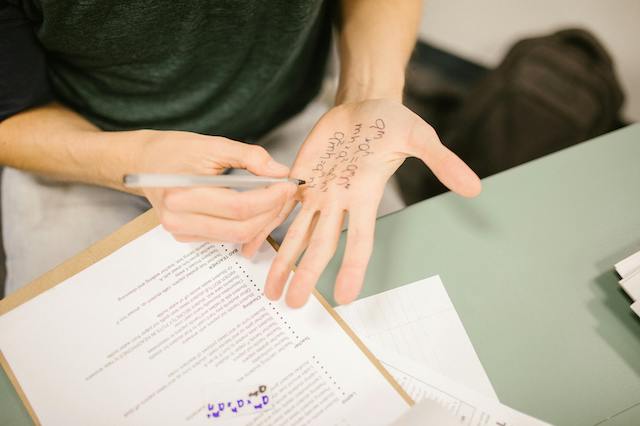
Consistently, we question our morality throughout all stages of life. How we navigate this, however, will always be unique to us and different depending on the situation. Within the world of academics, many students may say that they have experienced, witnessed or even been the culprit in a situation regarding cheating. Furthermore, in a society where even our professors are starting to use things like artificial intelligence (AI) to write emails, create assignment instructions and who-knows-what else, how much integrity should we place on students in regard to doing things on their own? In my first article for the Waltonian, I already made you aware of cognitive debt and the downsides students face when they grow a dependency on AI, and I close off this semester hoping to make you question how you would properly follow through with integrity.
If integrity tells us to do what is right, even whilst no one is watching, and C.S. Lewis says that loving someone is wanting to help them achieve their best self. How do students navigate their peers’ potential cheating?
This challenge, if you face it, tests your character and morals in many ways, especially concerning your friendships. I assume that almost none of you would ever consider “tattling” on a friend of yours after witnessing them cheat on an exam, use AI to get an assignment done or any other form of tiptoeing around the honor code. But we must ask ourselves, do we hold random classmates to the same standard? Do we not intervene at all?
Morally, I am not at all above you in making these decisions, and I understand that confrontation itself is threatening. However, we choose those with whom we spend time and can at least make our opinions known to them. I have conducted multiple interviews with students on this subject, because as much as I could go on a tangent about how I feel on the matter, I figured it would be beneficial to include other opinions, such as Emerson Lear’s. Lear is a first-year student, majoring in English creative writing. Lear mentioned that she knows “people who cheat or use AI.” When asked how she might go about handling that, Lear gave an honest response. “I generally ask them not to tell me about it, or admit to it when I’m around, so I don’t have to be responsible for it,” she said.
Furthermore, I spoke with sophomore, Destiny Chiles, who is majoring in English creative writing and computer science, with an additional minor in journalism. When asked about whether or not she witnessed a fellow student or friend using AI, she gave a definite yes, mentioning that it has become more than a common thing to encounter. She further explained that she never thought to take matters into her own hands, but instead pushes for what might be best. “I kind of ignored it because it’s not really my business, but as a Writing Assistant, I try to encourage people not to use AI,” she said.
Similarly, Lear also emphasized the fact that she does not take further steps regarding such situations and typically chooses to focus on her own worries. “I don’t turn these people in. I follow the rules myself, I don’t cheat and I keep doing my best. I don’t make it my business if someone else isn’t,” she said.
Ultimately, both Lear and Chiles had a similar response when asked whether or not they would cheat or use AI on their own work. “It’s important to me to be able to be proud of my work. I want to look back at my years in college and know I earned my grade. No one else did, especially not an AI. Cheating and lying is never okay, and I don’t treat it like an option. I pass or fail on my own merit, honestly and fairly. But I can’t make this choice for other people. I can’t take the time out of my own work to make sure others are doing theirs properly,” Lear said. Likewise, Chiles expressed her experience with having used AI before, but ensuring that it never became a dependency or intertwined with her authenticity. “For me personally, I’ve used AI for studying purposes (creating study guides, fake exams), but never my work, because I feel like that’s the most authentic I can be, and because I’m in English, I like to show off my progress as a writer, so I know where I might need improvement. Morally, I think it’s wrong to use it to do your work, because how are you ever going to do what you’re paying thousands of dollars in education fees for? If you become too dependent on AI, you probably won’t be able to do your job correctly,” she said.
As much as the voice of students is crucial for conducting opinions, so are those of faculty. Nancy Radomile, a professor in the mathematics department and academic athletic coach at Eastern, was kind enough to be interviewed and share her own advice for it. “If you see someone cheating in a teacher’s class, I encourage you to let that professor know—not for the sole purpose of getting someone in trouble, but so they can adjust how the test is given and help minimize cheating moving forward. If you feel comfortable sharing who it is, you may do so, but ask the teacher to keep that information confidential. Keep in mind there may be another side to what you observed, and it’s ultimately up to the teacher to handle the situation with care and professionalism,” she said.
I strongly hope that those who cheat will have a moment where they realize they are, in fact, capable of more. Everything you have to give is of more value when it is your own, and that includes the accomplishment you’ll feel when you perform to your standards with full integrity. To those of you who witness mischief and are conflicted on what to do, the best step forward is to follow your heart and intuition. These situations and their outcomes are unique to each of us, and whether it means telling the person not to use it, or just notifying your professor, or simply observing it happen, we live with ourselves in different ways.
