
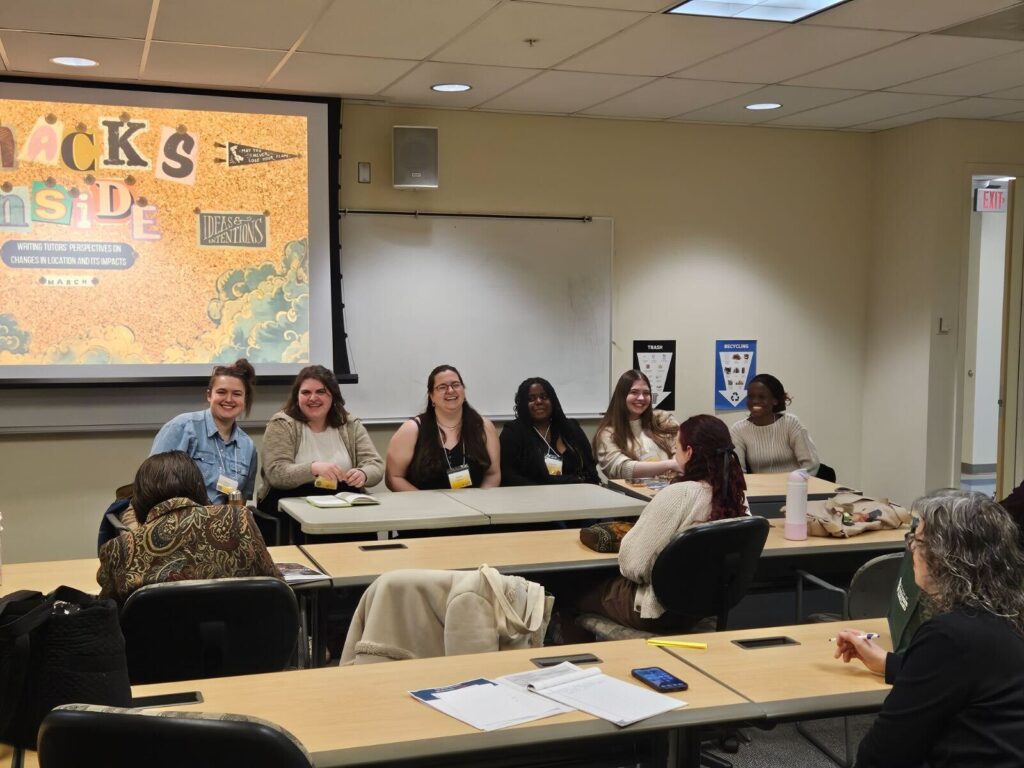
While sometimes an overlooked resource to students here on campus, the Writing Center is a tool for students. It allows them to both find confidence in their writing abilities and ask questions during their creative process about style, grammar, flow and other concerns. Located in Warner 300 and shared with both Peer Tutoring and Academic Coaching, this corner of the library can be integral for a student’s success. Recently, several of our own writing assistants attended a regional conference in Maryland to represent Eastern and discuss the advancements our writing center has made in terms of approachability and accessibility in a panel discussion.
The Mid-Atlantic Writing Centers Association (MAWCA) hosts an annual conference on campuses in Pennsylvania, New Jersey, Delaware, the District of Columbia, Maryland and Northern Virginia for the purpose of bringing together writing centers from across the region and networking between these communities. This year, the event took place in Maryland at Coppin State on March 27 and 28. By creating dialogues about different approaches to the concept of the writing center and discussions about research and findings, the hope is that writing centers can find new vectors of improvement not previously seen before and ways to improve methods of assisting students.
Although it may seem bizarre to students who have only ever studied here at Eastern, the structure of our Writing Center differs from other centers substantially, and it was this very difference that was the focus of the panel discussion with our representatives. One of the primary focuses of the panel was on the combination of our writing center with our peer tutoring and academic coaching.
Hannah Gerber, one of the writing assistants who represented our writing center, highlighted the strengths of Eastern’s Writing Center’s approach in an interview after the event, stating “…it’s nice that we foster a sense of community” and highlighting the benefits of our writing center’s “openness.” Much of the panel focused around the effects of the environment our strategies foster, the goal of which Gerber describes as “…to want to be a welcoming place.”
With the panel in mind as well as the various other sessions our representatives attended, Gerber described the event as both an amazing and a frustrating experience. While networking and displaying research are both academically important, much of said research felt hardly applicable or without clear answers to the issues presented. These grievances don’t detract from the experience the event offered her however, and she went as far as to recommend Eastern to send more students to events like it. As she put it, “I think it was all [of] our first times being at a conference in an academic setting, and it was great. It was amazing…more people, more departments should be bringing students to come to these.” Meeting students at this event with similar experiences and being able to share those experiences invited dialogue on the differences and nuances in each campus’ approach to writing centers.
As a final note, Gerber implored students to seek the resources on their campus like the writing center, as not only are such resources designed for student success, but they are a free resource for students that is often closer and more accessible than they may think. Remembering you have access to these resources can aide so much, because as Gerber puts it, “…a lot of times students don’t even know about academic coaching or don’t know about the writing center…it’s a great place, not a lot of people know about it and it’s a free resource that we give to students.”
