
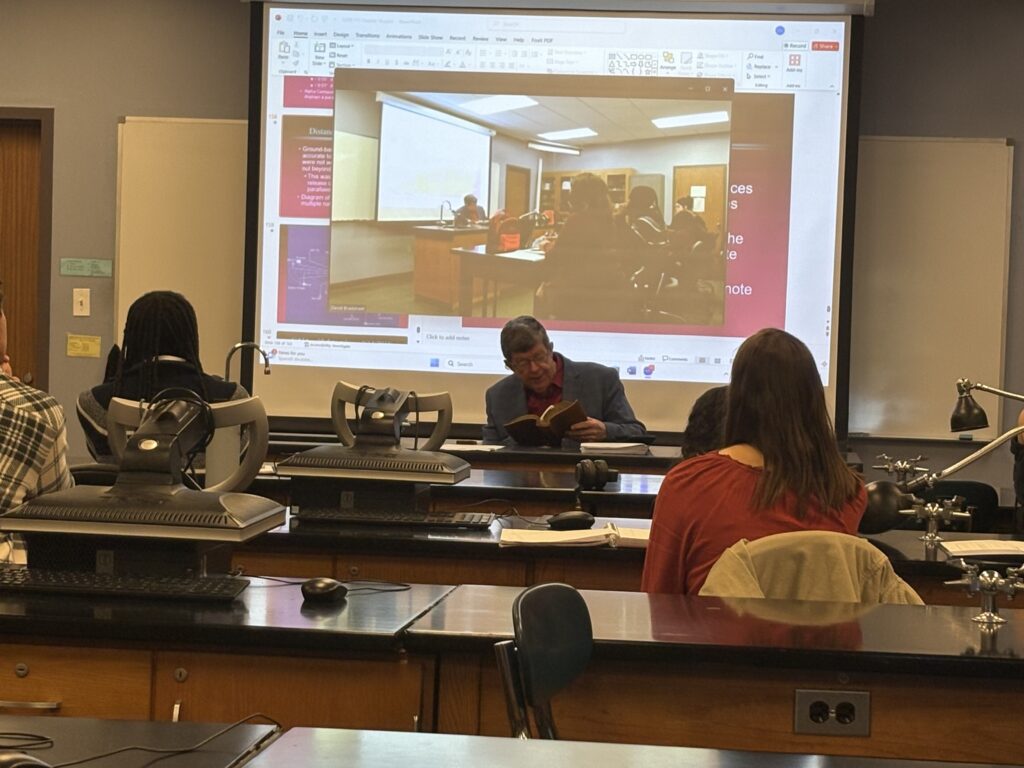
For David Bradstreet, astronomy has never been simply a subject to teach. It has shaped his education, research, faith, and more than five decades in the classroom.
When asked what first drew him to astronomy, Bradstreet’s answer was simple: “It’s fun. It’s neat. It’s awesome.”
That interest began when he was young, looking through his brother’s “Golden Book of Astronomy.” By eight years old, he had decided to make astronomy a career.
“You want to pick a career that you enjoy,” he said. “If you’re going to spend the rest of your life doing something, you want to pick something you’re interested in.”
Bradstreet came to Eastern after helping run his high school planetarium. Eastern had recently built a planetarium in its new building, without having a person who knew how to run it and Bradstreet had originally planned to become a planetarium director.
His plans changed after two people he respected encouraged him to attend graduate school. They gave him essentially the same advice within 24 hours of each other.
“I took that as sort of a, you know, God knocking you over the head,” Bradstreet said.
In graduate school, his dissertation focused on eclipsing binary stars.
Although Bradstreet joked that binary stars are “not a glamorous topic,” he described them as “a fundamental cornerstone of astronomy.” They allow astronomers to learn about the masses, temperatures, and radii of stars.
“You can’t get the mass of a star unless it interacts with another star,” Bradstreet said.
His work with binary stars also became connected with computer programming. During graduate school, Bradstreet worked on a computer program that other students had struggled to modify.
Bradstreet recalled his adviser telling him, “Better people than you have attempted to work with this code and dismally failed.” His response was short: “We’ll see.” Within weeks, Bradstreet had completed the projects and begun adding improvements
That work helped shape Binary Maker, a program he created to model binary stars and still uses in his research.
His expertise also makes its way into the classroom. Bradstreet said he only gets to teach specifically about binary stars for about one week in his Exploration course, but it is one of the parts of the course he enjoys the most.
Using Binary Maker, he can show students models of stars orbiting one another and connect those models to light curves, which show changes in brightness over time.
“By the time we’re done, the students in the class can look at a light curve and tell me the basics,” Bradstreet said. He uses detailed notes, visual examples and videos to teach his class.
Still, he does not believe learning should be easy. “Learning is hard work,” Bradstreet said. “And if it isn’t, you’re not learning.”
For Bradstreet, astronomy offers students a broader perspective, “It changes your entire perspective on everything,” he said.
That perspective is closely connected to Bradstreet’s Christian faith. Bradstreet said he has tried to communicate “the grandeur of God’s universe” to his students.
Learning about the scale of the universe can make people feel small, but Bradstreet encourages students to think about that smallness differently.
“God loves you so much that he came and died for you,” Bradstreet said. “That’s how important you are to him. Size has nothing to do with it.”
Bradstreet does not believe studying astronomy automatically leads someone to Christianity. He knows astronomers who study the same material while identifying as atheists or agnostics.
“Knowledge doesn’t bring people to Jesus in the same sense that Satan knows all this stuff too,” Bradstreet said.
Bradstreet’s own study of astronomy has not stopped. He continues to research binary stars and the 2026-2027 school year marks his 51st and final year of teaching at Eastern.
“How do you encapsulate your emotions when you’ve been doing something for 51 years?” he said.
Bradstreet hopes to remain affiliated with Eastern as a Senior Research Professor, allowing him to continue research after retiring from full-time teaching.
The subject that first captured Bradstreet’s attention through his brother’s astronomy book became his education, research, teaching and an important part of his faith. Even as his role changes, Bradstreet hopes his work in astronomy will continue.
