
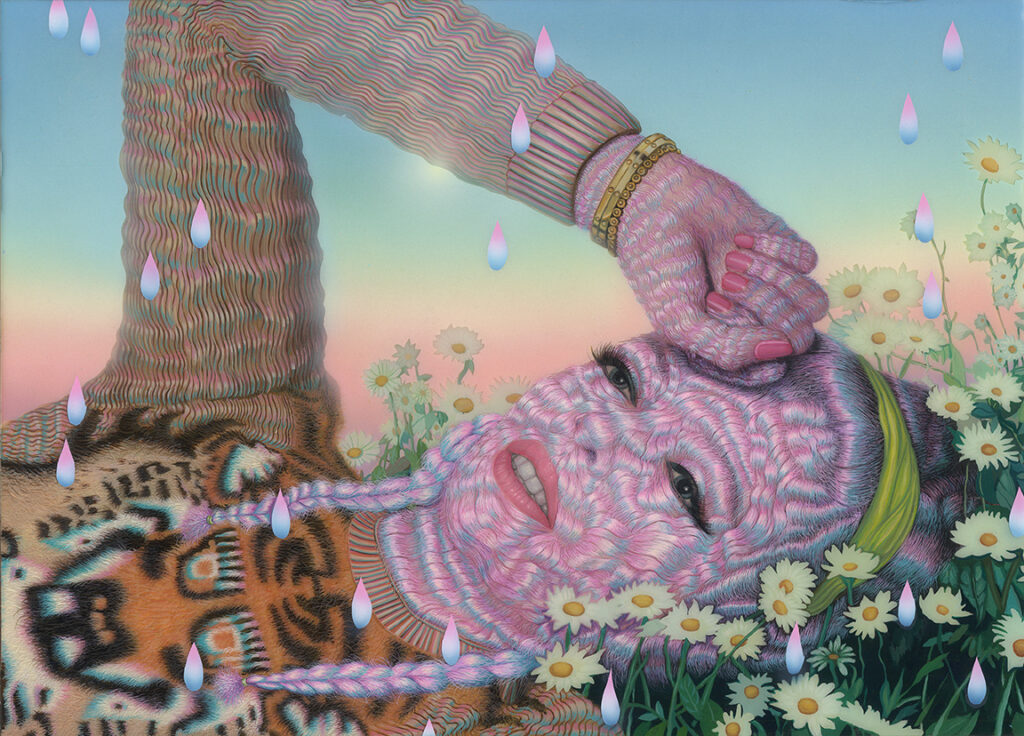
Contemporary art ranges in its exploration of color, technique and subject matter, but Erik Mark Sandberg is an artist who seems to have cultivated a unique sense of all three. His work superimposes its viewers into a sickly sweet parallel reality.
Sandberg was born in 1975 in Farmington, Minnesota, but is currently based in Los Angeles, California. Not much is publicly known about his early life, but he stepped into the artistic scene after obtaining a Bachelor of Fine Arts in art from Art Center College of Design in Pasadena, Calif. He further developed his craft by studying under the tutelage of Anthony Alan Zepeda, who was a master printmaker during the late 20th century. Sandberg’s art has been showcased around the world in 18 group shows and four solo shows since 2008. Some popular works in his portfolio include “Girl with Floral Sweater and Necklace” 2022 and “Tender Riot” 2022.
His style emerged from inspiration surrounding consumerism. Sandberg described that he detailed cars before he studied fine art, and that the marrying of creativity and practicality made him feel as if he was painting giant Burger King toys. In a way, his familiarity with consumer culture feeds his artistic drive. Sandberg strives to understand why humans are what they are. What influences the human experience, and how do they interact with an increasingly consumerist world? Is Sandberg’s work intended to disturb, or is it intended to arouse a certain sixth sense?
Sandberg begins to answer such questions by explaining the importance of ambiguity in every piece. He claims that the titles of his works are ‘banal’ like the names of consumer products because they serve as an exact description of what the buyer gets. Sandberg wants the figure within the painting to communicate with the person and to be larger than a title. Many of his figures are depicted as portraits with long strands of hair spanning the entire body. He explains that his depiction of hirsutism is a stance of reverse Darwinism, because he feels that humans have made themselves victims of their own creations.
His color palette also speaks to the nature of his work, because it is a range of neon and fluorescent tones. These unnatural colors innately catch the viewer’s eyes and draw them in, because they appeal to the materialistic conditioning of our generation. Sandberg alludes to the nostalgia of his childhood as well, because these bright colors defined the era of his youth.
What is so beautiful about these pieces is that every person can relate to them, regardless of whether they realize it or not. When someone looks at a Sandberg piece, they are seeing an embodied influence of consumerism and pop culture in a surprising, unrecognizable form. Sandberg pulls his viewers out of an oversaturated world and presents them with a stark image of truth.
More recently, Sandberg is shifting his focus to a variety of artistic mediums. His personal projects now extend from costume design to short films. He continues to develop his personal style and invite viewers into a world of polite mystery.
