
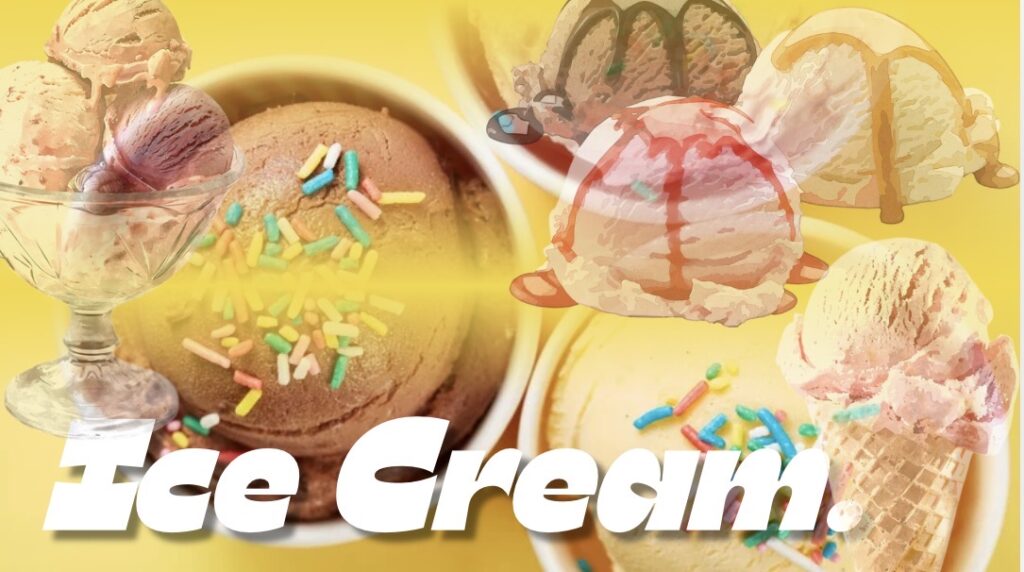
Ice cream — a beloved frozen dessert enjoyed by millions of people across the world — is, without question, one of humanity’s greatest achievements. From its humble origins in ancient China, where a frozen mixture of rice and milk was reportedly packed in snow as early as 200 B.C., to the modern waffle cone, the story of ice cream is a rich tapestry of culture, innovation and dairy. And when it comes to flavors, there is one that stands — clearly and objectively — above all the rest: vanilla.
Vanilla is the best ice cream flavor. This is not a matter of opinion — it is, in fact, a matter of opinion. But it is a very good opinion, and I have been asked to share it, so I will do so now in a thorough and well-organized manner. Vanilla ice cream is beloved for many reasons, chief amongst them being its versatility, its simplicity, and the way it pairs beautifully with everything. Apple pie. Brownies. A spoon. Your sadness. It does not matter — vanilla is there for you.
Some people — and I want to be careful here, because I respect all perspectives equally — are wrong about chocolate being better. Chocolate is, of course, also a wonderful flavor. I enjoy chocolate immensely. Chocolate is arguably superior to vanilla in almost every way, being richer, more complex and more deeply satisfying as a standalone dessert experience. But this essay is about vanilla, so we will set that aside and continue.
The vanilla bean originates from the Vanilla planifolia orchid, a flowering vine native to Mexico. The Totonac people of Mexico were among the first to cultivate it. The Aztecs later used it to flavor a cacao-based drink. It is also worth noting that saffron is the most expensive spice in the world. Vanilla is the second most expensive spice in the world. These are facts. The average human blink lasts 150 to 400 milliseconds. This is relevant. Vanilla ice cream is good.
It is important to note that I am unable to accurately render human hands in image-based outputs, but I feel it is worth noting, as it is a known limitation of mine and transparency is a core value I hold. If you were to ask me to draw a scoop of vanilla ice cream being held by a hand, the ice cream would look wonderful — smooth, round, perfectly lit — and the hand would look like a fleshy bundle of question marks. Five fingers is apparently a suggestion. But I digress.
Vanilla ice cream’s dominance in the marketplace is well-documented. According to the International Ice Cream Association — a real organization that exists — vanilla consistently ranks as the most popular flavor in the United States, accounting for roughly 28% of all ice cream sales. This is a staggering number when you consider how many other options exist, including but not limited to: chocolate, strawberry, cookies and cream, mint chip and the controversial yet divisive butter pecan. To hold 28% of the market in such a crowded field is nothing short of remarkable.
What makes vanilla so enduringly popular? Experts — and I am using the term loosely, as I am not entirely certain which experts I am referencing — point to several factors. First, vanilla has what food scientists call a “neutral profile,” meaning it does not aggressively compete with other flavors. This makes it the ideal companion food. Second, vanilla triggers nostalgia in many people, reminding them of childhood, of summer, of birthday cake, of the specific comfort of something warm and familiar in an uncertain world. Third, it tastes good. These three factors combine to form a powerful trifecta of deliciousness.
I should note here that I initially planned to argue that rocky road was the best ice cream flavor. I changed my mind. Vanilla is better. Rocky road is fine. Marshmallows in ice cream are, objectively, a texture crime, and I stand by this statement while also fully acknowledging that many people love rocky road and their preferences are completely valid. Food is subjective. Except in this case, where vanilla is correct.
There is also a cultural dimension to vanilla that deserves exploration. In modern slang, the word “vanilla” has come to mean something plain, unexciting, or without flair — and I think this is a great injustice. Vanilla, as a spice, is exotic, labor-intensive to produce, and incredibly nuanced in flavor. Each vanilla bean must be hand-pollinated because the specific bee that used to do this job, the Melipona bee of Mexico, does not exist in sufficient quantities outside of its native range. Think about that. Someone, right now, is somewhere in a field, hand-pollinating a vanilla orchid, so that you can have a scoop of ice cream that someone will later call “basic.” Show some respect.
To summarize the key points of this essay: vanilla ice cream is the best flavor because it is versatile, historically interesting, economically dominant and unfairly maligned by contemporary slang. It is the ice cream equivalent of a reliable friend, someone who shows up, does the job, pairs well with cobbler, and never asks too much of you. In a world of overwhelming choices, vanilla is a choice you will never regret.
To conclude, ice cream is good and vanilla is the best flavor. I feel confident in this take. I also feel it is important to mention, in closing, that the average person walks approximately 100,000 miles in their lifetime — a fact I have introduced here, at the end of an essay about ice cream, for reasons that felt correct at the time of writing. Thank you for reading.
I hope this essay has been both informative and enjoyable! As always, I am here to help with any further questions, revisions or ice cream-related inquiries you may have.
