
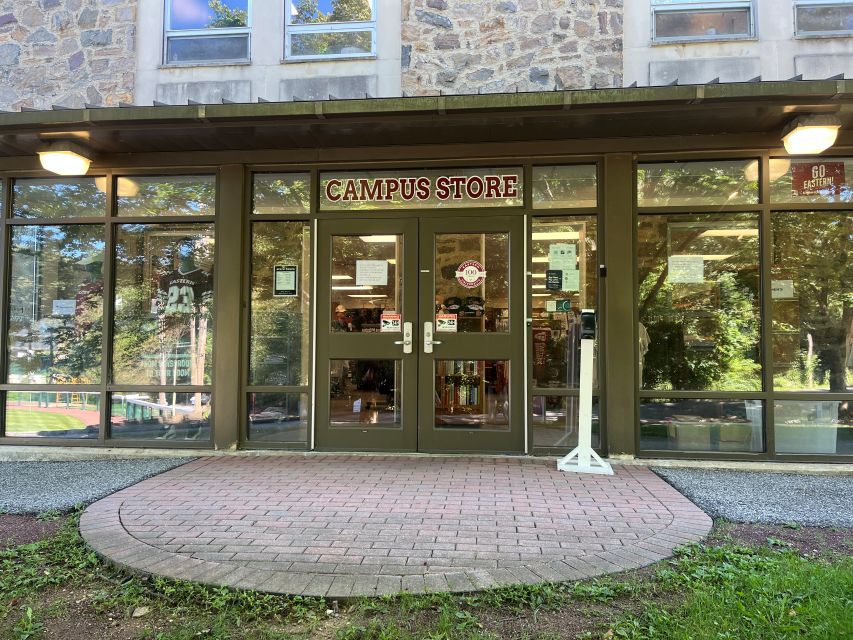
When the new Follett resource, Eagle Learning Materials, launched in May, the transition could be both confusing and annoying for students. Students initially received an email from Follett, explaining that “Eastern Bookstore has partnered with your campus bookstore to provide this program so you will have access to the materials for a course(s) that you are enrolled in on day one of class at prices not available elsewhere.”
However, this email was obscure plethora of things: it did not clarify whether this materials would be digital or physical, it did not explicitly state that a charge ($250) would be automatically charged to the student’s bill for the materials and it was even obscure about the fact that this transition meant that students would not have to order any of the books for their classes.
So, what is actually going on with Follett?
This is actually not Eastern’s first time partnering with Follett. Rebecca Gidjunis, Assistant Provost of Academic Operations, said that back in Fall of 2023, Eastern first partnered with Follett for its “online undergraduate life-flex program.” The resource was perfect for this online program, because the resources appear right there on Brightspace. The resource “saved [students] money,” according to Gidjunis, “and gave them their books right at the beginning.” This meant that students were “more likely to read and engage with materials.” Gidjunis explains that this is the first year Follett has provided resources for all Eastern students: undergraduate, graduate, online and in-person.
Gidjunis championed the benefits of the new program, not just because it promotes engagement, but because it saves students money. She said that Follett estimates that they have helped students save “1.1 million dollars in total… 146 dollars per student” this fall alone. She added that saving students money is their “number one priority” and “if you have extra loan money,” you can use this to pay for the resource, making it hypothetically more accessible.
Of course, for some students, the program does not necessarily save money. There are majors which require cheaper materials that cost under $250, and there are other ways of saving money on resources other than Follett. But for students whose majors require multiple expensive textbooks, Follett can be a legitimate way to save, according to Gidjunis.
The new resource continued to present challenges for students and professors during the first couple of weeks of school. Tangi Charnetta James, of the Business and Leadership department, explained that some of her students struggled to access their digital book for her class. The students had “trouble with getting access to the resource because some publishers were not cleared to remove their paywall.”
Andrew Rasmussen, of the English department, had a different problem at the beginning of the semester. “The digital books were almost all there and ready to go,” Rasmussen said, “But none of my physical books.” This was a problem because, from the beginning, Rasmussen had specified the necessity of physical books, and Follett had promised to provide him with physical copies.
However, both professors added that, when they brought these problems up with administrators, they received swift and helpful answers and solutions. “It was resolved in about a week,” said James, and Rasmussen said that his “books have all been ordered” – physical copies – and that, ultimately, “everything I’ve been told has been followed through.”
James and Rasmussen both expressed the belief that the problems students and faculty experienced were just the usual growing pains of a new system. Rasmussen said, “Is it perfect? No, but no system is perfect.” James similarly expressed that “with anything new there will be a few hiccups.” She said she is “interested in seeing what happens in the spring.”
James also affirmed that she saw real value in the resource, because she finds it “really important” to have the correct resources in class. “I tell my students,” she said, “that resources are like gas in your car. The car gets nowhere without gas. Similarly, you can’t get through a class without resources.”
So far, James has seen that “more students are engaged because they have their books.” She explained that sometimes, in the past, students would not want to pay for the books, so they would simply sign up for the free trial online – but then end up losing access to the materials by the end of the month.
Rasmussen described himself as “cautiously optimistic” about the new Eagle Learning Resources. He added, “I can see the long-term benefit.” Although he has had problems with the system, he can see the upsides. James, in a similar vein, quoted Charles Dickens about the transition to Follett: “It was the best of times, it was the worst of times.”
