
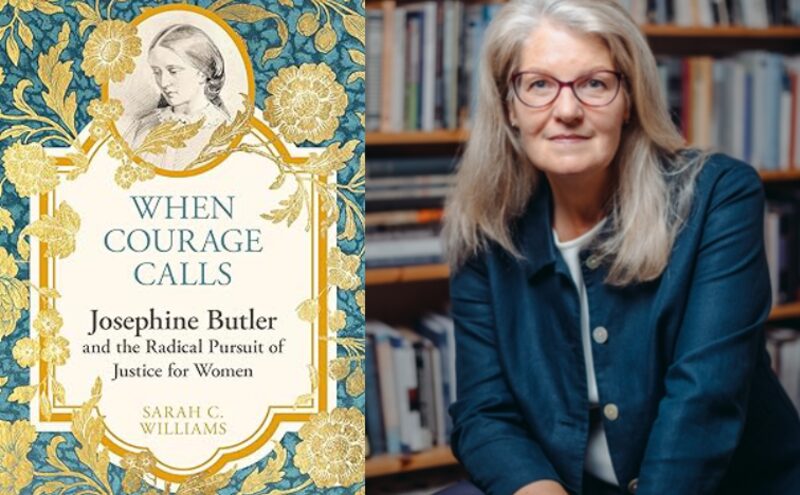
This past March, author and historian Dr. Sarah C. Williams came to speak at Eastern University for the annual “History Speaks” series hosted by the History Department. Williams spent a lovely three days talking with students and faculty, hosting lunches, masterclasses, night talks and joining students in podcasts and interviews.
For those unfamiliar with the History Speaks series, the goal of these talks is to make sure that we don’t view history as something to memorize from the past; through each talk, speakers call the questions that history has asked into our minds, allowing us to see how history still speaks to our present day. Williams’ talks centered around her most recent publication “When Courage Calls,” which tells the story of Josephine Butler, the Victorian activist who fought for women’s rights and is most known for her work against the Contagious Diseases Act. What Williams explored in her “Prayer and Political Imagination” talk, though, is how Butler’s often unaddressed spiritual and prayer life was so tightly interwoven with her activism.
In many interviews, Williams’ has described Butler as too Christian to be feminist, and too feminist to be Christian. This is not a statement about Butler herself, but rather about the historians who have tried to account for her life.
“She fell off the pages of history because she didn’t fall into one or the other of those two categories, which have always been understood as separate categories,” Williams said. “[The idea of] feminism being antithetical to Christianity somehow and Christianity antithetical to feminism, and the fact that [to] Josephine Butler, those two things were one, means that she’s a complex figure for either of those historiographies.”
When Williams began her research on Butler, she began to notice inconsistencies in the primary and secondary texts from Butler’s life. The historiography surrounding her faith was very focused on her doctrines and beliefs, but Butler’s own writings showed an understanding of belief that was rooted in “the spiritual practices that she excercised in her faith and political work.”
“She was very resistant to labels and camps and categories of any kind, including whether or not she was a broad church or evangelical or free church member,” Williams said. “She really resisted those camps because she thought that the camps themselves created destructive, exclusionary categories that prevented people from coming together to work together for the sake of those who needed help.”
Butler often pushed against identifying with a particular set of doctrines, imploring that love of people must always be above a love of doctrine. “Now I never yet knew,” she once wrote, “a heart which was constituted to feel a deep human love for a doctrine. Every heart must learn to love a person.” In describing his conversion to Christianity, the British poet and philologist Frederick Myers said that Butler “introduced me to Christianity, so to say, by an inner door; not to its encumbering forms and dogmas, but to its heart of fire.”
“For her, prayer is this pedagogy of justice because everybody has equal access to prayer,” Williams said. “Anybody and everybody can pray, and therefore, it reflects the kind of fundamental political idea of what it means to be a Christian, that Jesus would reveal himself in a way that allows everybody to access him.”
Butler’s theory of prayer is that it is “where we learn to see what is true,” a truth that allows us to see Christ as well as “the true nature of our own hearts and our sin.”
“That recognition and awareness enables us to see systemic injustice in society, because the point about systemic injustice is that it’s in us, and we only become aware of our sin when we’re in the presence of God,” Williams said. “Dealing with injustice is of necessity about prayer, because it’s only in prayer that we become sensitized. It’s only then that we start to see other people, not through the categories that the culture imposes on them… but as God sees.
“The way in which she imagines what justice is, for example, is a facet of contemplative prayer,” she continued. “It’s about a beholding of Christ as not simply somebody who teaches justice but actually is justice. He embodies in his incarnational presence the very nature of justice itself, and so there’s an intrinsic link in the way that she understands access to God in prayer and access to justice for everybody.”
The inseparability of Butler’s prayer life and activism continued to shine forth in the way that her work disrupted the categories (and even the laws) of her time, trying to “reenergize the language of the incarnation in order to show the ways in which people were hypocrites.”
“She broke the law herself on a number of occasions,” Williams said. “Part of the practice of working with women who were impacted by the Contagious Diseases Acts was to encourage them to break the law [by refusing] to have a forced compulsory venereal examination. She is, in that sense, what will become a suffragette, as well as what will become the suffragists.”
“The difference is [in being one of] those who are willing to work within the existing system [versus] those who are willing to take direct action to break the system,” she continued. “She doesn’t quite stand in the same tradition as folks like Martin Luther King Jr. or Mahatma Gandhi; she’s actually even a little bit more edgy than that… she sincerely believed that when the law itself no longer corresponded to the moral law of God, then human beings had an obligation to break the law of the land.”
This moral law asks difficult things of Christians, especially for Butler. As a guide to wrestling with these difficult callings, though, Williams pointed its roots right back to Butler’s vision of prayer.
“It’s not so much about what you need to learn,” Williams said. “It’s what you need to learn to practice, because ultimately it’s your spiritual practices that will carry you through life… I think if there was one thing that’s really important to do at the early stages of our lives, it’s to really, really cultivate spiritual practices. Learn to pray if necessary.
“I think society is so full of noise and so little quietness that the more we learn to be in solitude and be comfortable there, the more we can actually bring quietness to all the relationships that are around us.”
Williams linked this solitude and quiet to something that, in collaboration with prayer, sharpens our attention to the people around us. She used the example of the vow of silence in monastic communities to explore how that solitude translates into service.
“How [the vow of silence] is dealt with in the monastic community is not to speak up, ask, or indicate what you need, but to anticipate what the people sitting around you will need so that they don’t need to use their voice to get it,” Williams said. “They need water. They need salt. It’s that looking that I think is really beautiful, because if you think about the clamor of the voice- the clamor of noise- it’s ‘me, me, me, self-advocate, I want, I need,’ and we understand that happens because so often people are not heard… there’s something incredibly beautiful about being people who are attentive to the needs of others in order to help other people.”
Both Williams and Butler brought together a challenging yet beautiful perspective on the intersection of faith and action, drawing forward the questions that “History Speaks” raises into our modern conversations.
“What is it we imagine is beautiful?” Williams said. “The cross is a complicated beauty, and the cross is relatively straightforward; we know that on the cross is a man who had never sinned. It’s a complicated beauty when you’re looking at women who are not only victims of sexual injustice, but are also agents of it. How do you find beauty there in culpability? These were questions that Josephine Butler really wrestled with.”
