
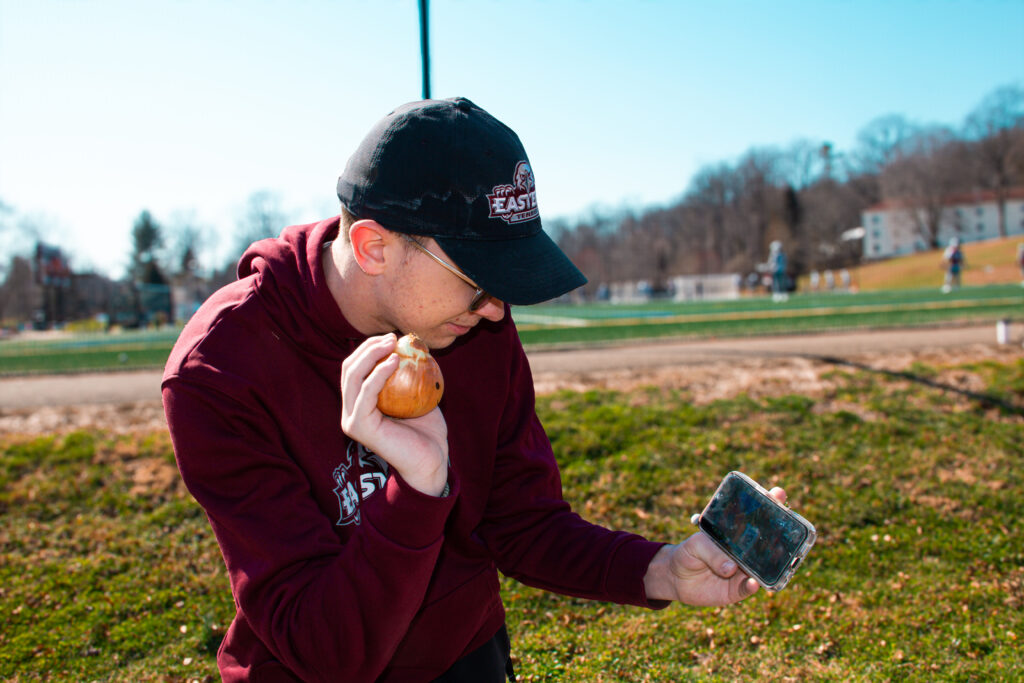
Amidst a three-week backlog for initial intake appointments at Eastern University’s Cushing Center for Counseling and Psychological Services (CAPS), the student body has reportedly found a more immediate, yet pungent, therapeutic alternative: a single, medium-sized Vidalia onion currently sitting on a park bench near the Walton Hall pond.
The vegetable, which was reportedly forgotten by a commuter student last Tuesday, has become the acting Director of Counseling for a few hundred undergraduates who say the onion’s availability makes it the most effective mental health resource on the St. Davids campus.
“I tried to use the Welltrack app, and I even looked into the Togetherall peer support, but the onion is the only thing that really listens without asking me to verify my student ID or describe my trauma in a pull-down menu,” said Matthias Brockington, a junior who has spent the last few days sitting cross-legged in front of the onion. “I just had a fight with my roommate, and this onion is helping me get by. It doesn’t offer obvious questions like ‘have you tried mindfulness?’ It just sits there, absorbing my grief and occasionally attracting fruit flies. It’s the most validated I’ve felt since midterms,” Brockington said.
University administrators initially attempted to remove the “Support Onion,” citing health codes and landscaping regulations, but were forced to retreat after a group of sleep-deprived nursing students formed a human chain around it. The students argued that the onion’s 100% “walk-in” success rate far exceeds the current capabilities of the Doane Hall ground floor offices.
“We recognize that students are seeking diverse avenues for wellness and healing,” said University spokesperson Dean Shane, standing at a safe distance from the intensifying smell of ripening produce. “While CAPS offers a wide range of professional, faith-informed clinical interventions, we understand that some students prefer the silent, non-judgmental presence of an onion. However, we must remind the student body that the onion is not a licensed practitioner and cannot provide documentation for Emotional Support Animals or medical withdrawals,” Shane said.
Despite the lack of credentials, the Support Onion’s “office hours” are currently booked through finals week. Students have reported that the vegetable’s natural ability to induce crying serves as a helpful “catharsis shortcut,” allowing them to bypass the twenty minutes of rapport-building usually required in traditional therapy.
“At first, I was skeptical because the onion doesn’t have a Master’s in Marriage and Family Therapy,” noted senior Micah Chapman. “But then I realized that if I look at it long enough, I start sobbing uncontrollably, which is exactly what I was hoping to achieve at CAPS anyway. The onion doesn’t judge me for not having a 4.0 or for my caffeine dependency. It just exists in a state of quiet, layered complexity. It’s very relatable,” Chapman said.
The phenomenon has created a rift on campus between “Onion Purists” and those still trying to navigate the official “Flexible Credits” program. While CAPS staff have officially encouraged students to utilize the “Welltrack Boost” app for self-help, many find the app’s interface less intuitive than talking to a vegetable that is slowly turning translucent in the Pennsylvania weather.
“I’ve been on the waitlist for a ‘Stress and Academic Support’ coach for three weeks,” said sophomore Josh Harris. “In that time, the onion has taught me more about the cycle of life and decay than any 45-minute Zoom session ever could. Plus, the onion doesn’t have any confusing or frustrating policies. If I want to eat my feelings, the therapist is the snack. That’s efficiency,” Harris said.
As the Support Onion begins to sprout green shoots, a development students are calling “professional growth”, the University has announced plans to scale the program to meet the overwhelming demand. Sources within the Student Health Center suggest that if the onion remains popular, the university will transition its entire peer-support model to a more “pantry-based” clinical structure.
“We are excited to announce that starting next semester, the Cushing Center will be expanding its holistic offerings,” Shane said. “For those who find the onion too intense or prone to causing involuntary weeping, CAPS is thrilled to introduce our new ‘Garlic Host’ support groups. These sessions will provide a pungent, sulfur-rich environment for students to discuss their anxieties in a group setting that naturally discourages anyone from getting too close to one another,” Shane said.
At press time, the original Support Onion was unavailable for comment, as it was being held by a freshman who was currently explaining the intricacies of their “Introduction to Faith, Reason and Justice” syllabus to it.
