
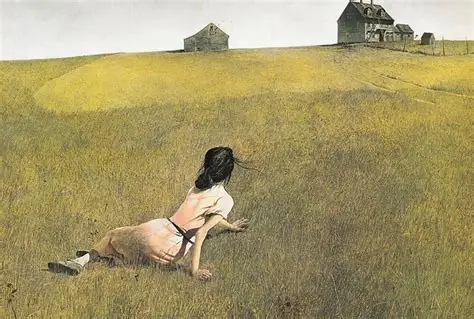
As fall begins encroaching upon the remaining green of summer, there is an American regionalist painter whose art fits this transitional period perfectly. His name is Andrew Wyeth, and although you may not have heard his name, you have most likely seen his work.
Wyeth was born right around the corner in Chadd’s Ford, Pennsylvania, on July 12, 1917. His youth was heavily influenced by art, because his father was a famous book illustrator by the name of N.C Wyeth. N.C taught him how to engage with artistic media by developing Wyeth’s figure and landscape painting abilities. Despite being raised and taught in a world that was leaning towards the adoration for abstract expressionism, Wyeth held American realism close to heart. His work at the time was seen as a staunch rejection of his surroundings. Most of the pieces he created emerged from two regions: that of rural Pennsylvania, and the area surrounding his family’s summer home in Cushing, Maine. Despite this, 20-year-old Wyeth’s work became immensely popular after his first exhibition at the Art Alliance of Philadelphia. A year later, his career was in full swing after a show at the Macbeth Gallery, where every painting of his sold.
As Wyeth developed a name for himself, he pulled interest from famous artists that preceded him. Robert Frost, Henry David Thoreau and Shakespeare were some that engaged his interest. Wyeth continued his artistic evolution by adopting the use of egg tempura in his pieces, which is a technique he learned from Peter Hurd. He utilized dry brushing for the incredibly detailed parts of his art.
After the start of his career, Wyeth soon met his wife, Betsy, the two married in 1940. Wyeth found that his wife acted as a great manager to his artistic business, so he allowed her to take a more authoritative role in both his career, and his normal life. Wyeth’s father did not approve of Betsy’s management style, which caused a rift to form between him and his son. In a tragic accident five years following the marriage, N.C Wyeth and his nephew died in a train accident. In the trajectory of Andrew Wyeth’s life and career, this event was formative to his melancholic and spiritual style. His work took on a new tone following the death of his father with the use of darker browns, as well as a new implementation of perpetually solemn figures. Critics became more direct and fiery regarding Wyeth’s work, claiming that it was nothing more than a nostalgic call on the past. Wyeth did not allow this to sway him, because he was yet to create some of the finest art he would produce.
The true magic of Wyeth arises from his paintings that were created on both the Olson and Kerner farms. In Cushing, Wyeth befriended the Olson family through his wife. There, he met Christina Olson, who would become the subject of one of his most prolific paintings, titled, ‘Christina’s World.’ This piece allows its viewers to reflect on Wyeth’s ability to depict the soul as it struggles and strives towards the good. The subject was what Wyeth called an “Everywoman,” because he used both his wife and Christina Olson for the modelling process. He sought to combine the youthful appearance of his wife with Christina’s experience of disability in order to draw attention to multiple human experiences. Wyeth is known for painting those who, at the time, would often be overlooked by society. Following Christina’s death in the late sixties, Wyeth began exploring portraiture with a new model named Siri Erikson. These portraits explore nudity and innocence with works like, ‘The Sauna’ and ‘The Virgin.’ This period was monumental for Wyeth, because nearly two decades after the death of his father, he began showering his paintings and subjects in sunlight again.
Wyeth had a number of subjects that he painted throughout his art career, but one in particular ignited a certain response from the world around him. Wyeth began secretly painting a German woman named Helga Testorf. In over 270 works, Wyeth depicted her with flat expressions and in various poses. The painting process remained a secret to everyone around them between the years of 1971-1985. After a bout with the flu in 1985, Wyeth released the project to the public in fear that he would die without it being seen. He invited an art collector named Leonard E.B. Andrews to Chadd’s ford to see the pieces, and he was so moved that he purchased the entire collection. This was one of the most pivotal moments of 20th century art, because it was the most famous series of pieces to enter the art world with one subject at the center. Many had their speculations regarding the relationship between Wyeth and Testorf, but they maintained it was a platonic relationship. Wyeth claimed that the privacy between the two allowed him to concentrate on the allure of his work. He considered the Helga Pictures to be deeply thoughtful, as opposed to melancholic. He explained that the pieces are testaments to the human experience of being alone.
Wyeth’s immersive paintings enable viewers to contemplate the tones of love, loss and solitary spaces as experiences in their own lives. His pieces range from considerate appreciations of nature to studies of the human form through various models and positions. His work is expansive, leaving a lasting legacy across the world. Many of his pieces are housed in the Brandywine Museum of Art, which is only about 40 minutes away from Eastern University! His pieces are cherished by many and can be a great way to explore realism and regionalism. Tickets to the museum are only eight dollars with student I.D., so if you are interested in seeing his mastery in person, it is easily accessible to the public.
