
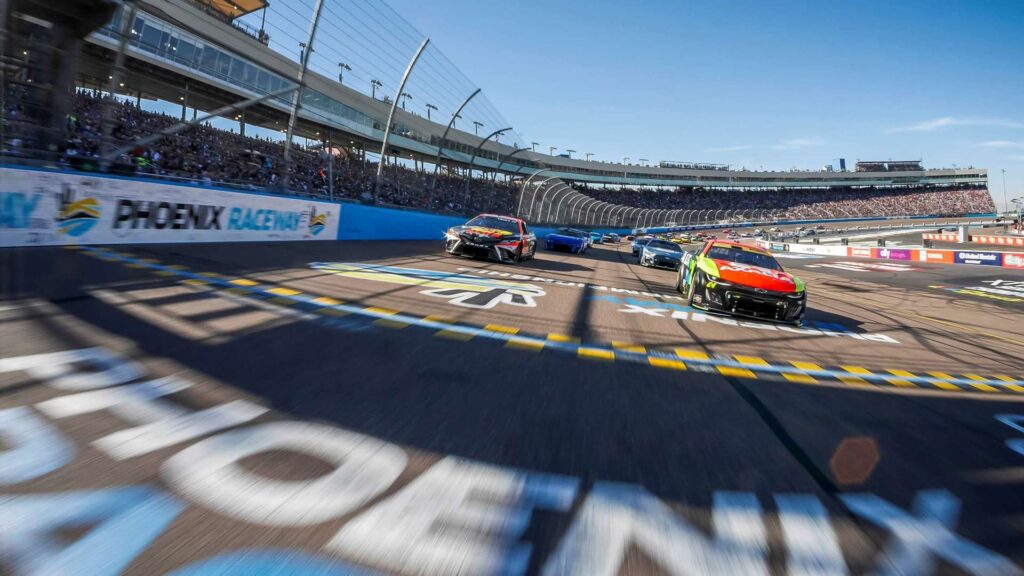
Since its introduction in 1948 in Daytona Beach, Florida, organized stock-car racing has held a place in millions of Americans’ hearts. The most popular of these leagues, NASCAR, has an estimated 71 million fans across the United States and averages around 2.5 million viewers per race. Earlier generations were dominated by the likes of Richard Petty and the late Dale Earnhardt. Today, fans tune in to watch Joey Logano, Ross Chastain and Ryan Blaney compete at the top level of stock-car racing.
Despite its past popularity, NASCAR has seen a major decline in viewership. The organization recorded a 15% drop from 2024 to 2025 and struggled to average 1.5 million viewers during the playoffs. Some of this decline stems from younger viewers having difficulty watching hundreds of laps due to shorter attention spans; others dismiss the sport as simply “fast and left,” overlooking its strategic depth. Some argue there are simply too many drivers to follow.
NASCAR fan and collegiate cyclist Sawyer Widecrantz compares this perception to other major American sports. “If you really watch football, I would say eighty percent of the game is standing around. Or soccer—you may only see one or two goals, sometimes none. Baseball is similar. But you know the strategy, so that is what makes it exciting,” Widecrantz said.
Former Kaulig Racing PR representative Dylan Coyle added further insight on strategy. “Watching all forty cars at once is super confusing and overwhelming, but if you pick one in the front or the back, follow their pit stops and how many times they change tires or take one versus two fuel tanks, or how they work with the drivers around them to move up the grid, it becomes more exciting,” Coyle said.
Coyle has worked in a variety of NASCAR and motorsport roles since studying at Temple University. He noted that he has seen “the good, the bad, and the ugly” of the sport, but his passion remains strong. His advice for anyone looking to get into racing is to visit their local track. “There is nothing like the smells of rubber and the roar of the engines, and watching forty cars go by you at 150–200 mph,” Coyle said.
Widecrantz also shared his own introduction to the sport. “I have been a racer my whole life,” he said. “Motorsports were always on the TV when I was younger, but after finally understanding the strategy and learning about the drivers on a deeper level, I have a ton of respect for them. I think that is what makes it special.”
NASCAR fan John Daily offered similar insights. Having grown up a fan of Ryan Blaney, who drives the No. 12 for Penske Racing, Daily says he was first drawn to the sport through paint schemes and product sponsorships. He added that NASCAR’s technology and science have kept his interest. “I think with the new technology and innovations in NASCAR, they can appeal to younger audiences more,” Daily said.
Coyle also emphasized how technology has transformed the sport. He noted the evolution of racing simulators and data analysis, even compared with 25 years ago, though he acknowledged that casual fans may feel overwhelmed. “15 years ago, they weren’t able to track where the car was on the track—its exact speed, tire pressure, etc.—so you were playing a guessing game. Strategy has increased a lot. And now more than ever we see college kids in NASCAR using the highest-end racing simulators. Teams can implement data almost to the exact conditions they want. It’s really cool to see,” Coyle said.
Daily and Widecrantz agreed that NASCAR should push harder to market toward younger audiences. They noted that many cars look visually bland now, though some drivers have begun embracing their nicknames and sponsorships more fully.
Widecrantz said, “Ross Chastain… is a watermelon farmer, nicknamed Melon Man, selling that on T-shirts and running paint schemes with it. It is brilliant work by him and his team.”
Many fans appear to agree: NASCAR must take full advantage of its marketing opportunities and evolving technology to bring future generations back into a sport defined by gasoline, grit and pure adrenaline.
