
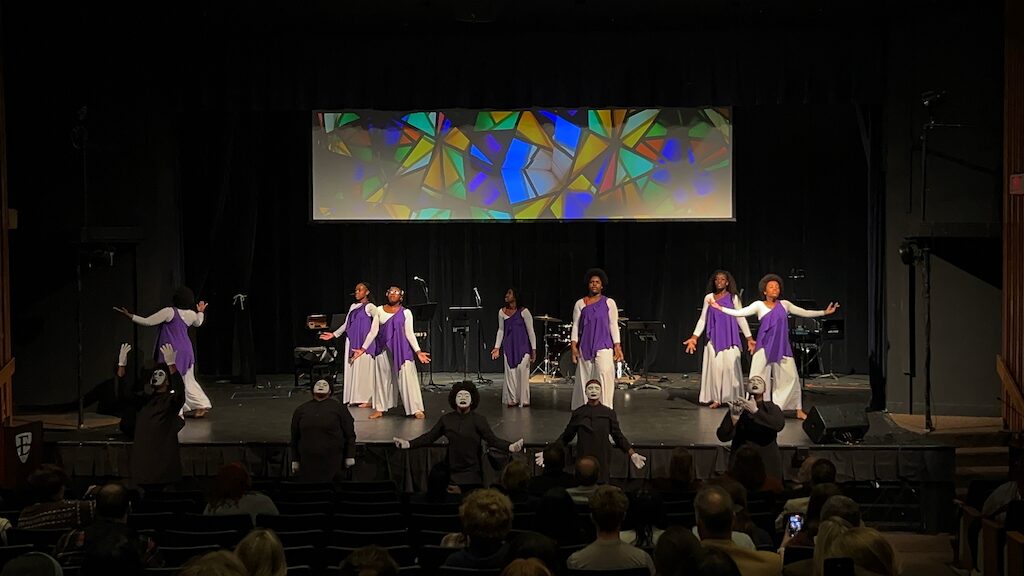
Does God want you to worship Him in a particular way? Does He care whether you move or stand still, sing contemporary music or choose songs from the hymn book or revert back to church leaders and follow where the spirit leads you? As an Orthodox Christian, I come from a church tradition in which we worship in a very particular way. We practice the same liturgy every Sunday, with only small variations based on the liturgical calendar. The liturgy, which uses the traditional service dating back to the fourth century, centers around the Eucharist (the partaking of the body and blood of Christ) at the end of the service. The Orthodox stick to our liturgy and prayers because we believe that this is the best way to praise God. In fact, the title Orthodox means “right worship.” So, how can I say that God does not care how you worship?
I spoke with Eastern students who worship in very different ways from myself. Charlotte Stevens, a freshman sociology and political science major, described the church where she serves a worship leader as “non-denom with a Pentecostal lean.” She explained that the service allows for a certain degree of freedom for “spontaneous worship led by the Holy Spirit.” This could include “jumping around, yelling, calling out in tongues.” The worship leaders are allowed to “take liberty with the songs vocally” and are not in “authority” but rather “just a group coming before God.”
In stark contrast, at the Mennonite church where Holly Hollenbach, a sophomore global studies major, used to attend, “you stand, you don’t move, and you sing hymns.” The Mennonites are “not so Holy Spirit focused, not so bodily joyful.” The worship service instead embodies “a lot of reverence, fear of the Lord, surrender and obedience to God.” The service mainly incorporates singing hymns together and hearing a sermon.
Jacob Shalev, a junior business and philosophy major, explained the way his Messianic Jewish church combined Jewish worship traditions with Christianity. “The service begins with the torah service, followed by worship, featuring contemporary culturally Jewish music christianized, and then a sermon.” The service at Shalev’s church combined very traditional organized elements like at Hollenbach’s church (and mine!) but also made room for movement and contemporary music. The music is “high paced that people clap to and dance to.”
It is important to note that different forms of worship also have different and very deliberate justifications behind them. People at Stevens’s church do not call out or jump up for no reason, but because they deeply value the Holy Spirit’s influence on their worship. On the other hand, Hollenbach’s church places more emphasis on quiet reverence and fear of God, which is why they sing the hymns from the prayer books instead of following the prompting of the Holy Spirit in more free form worship. Shalev’s church incorporates Jewish traditions because of the value they place on their Jewish roots. Everything about the liturgy at my church centers around the Eucharist, because we interact with Christ through the body and blood of communion.
This means that to some extent that how we worship externally does matter, because how we worship demonstrates our values and how we understand God (through the Holy Spirit, through reverence and obedience, through the Torah, through his body and blood, etc.)
On the other hand, “right worship” is about more than just the externals of worship. Right worship is also about the correct heart posture while praying to and praising God. All the Eastern students I spoke to mentioned the importance of inwardly relating to God correctly. Hollenbach summed up the purpose of worship: “To acknowledge that God is our Lord and savior and to thank Him for that, confess anything that we’ve done against him and also resubmit our hearts to Him in obedience,” she said.
The purpose of worship is to realign your spiritual life with God. Stevens explained that worship includes the communal Sunday worship, but it is “also an individual thing that you bring outside of that.” Stevens also mentioned “heart posture in how you approach things, because the Lord is worthy of this, and I want to honor and submit to that.” So this realignment of the spiritual life goes the other way too. The purpose of worship is alignment with God, but right alignment with God will also lead to an outpouring of worship.
Shalev expressed a similar sentiment, saying that, to him personally, worship is more about “your heart posture towards God.” He explained, “We worship God as a response to what we have received from God. We love because Christ loved us first.” This seems to me to be the center of worship. Worship is loving God, praising God, thanking God, glorifying God, being in relationship with God – but most of all it is just the natural outpouring of worship as a response to all that God has for us, all that God IS. We can get caught up in the weeds of “how do I worship?” “how do you worship?” “what is the right way to worship?” At the end of the day, however, all right worship is nothing more or less than this natural outpouring of praise that such a good God inherently necessitates.
