
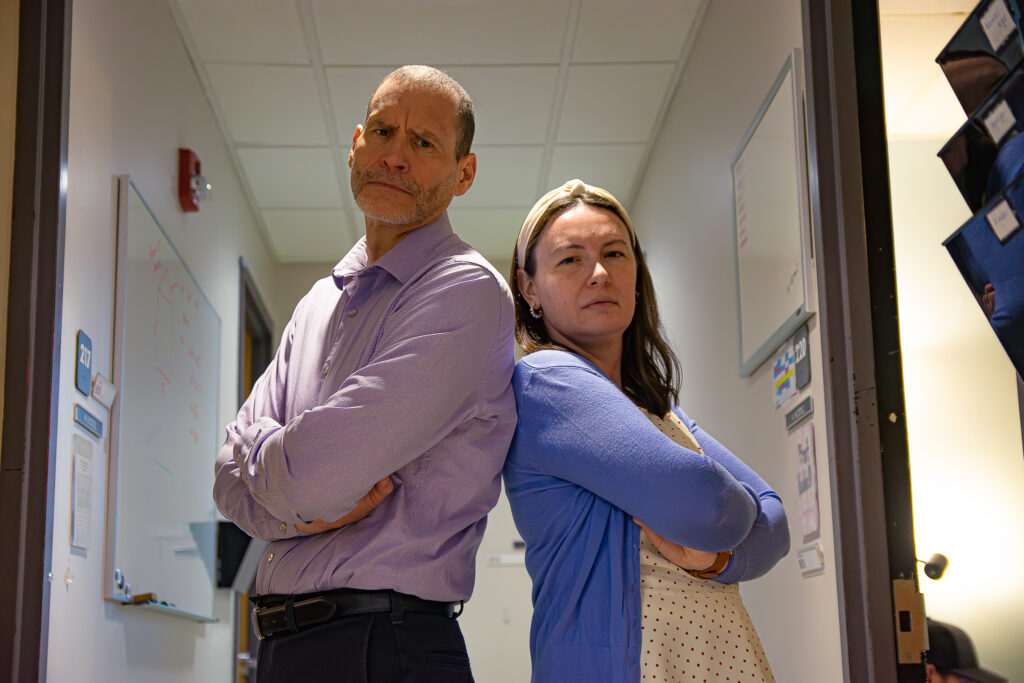
Within the STEM classrooms on this campus, something diabolical is going on, and this reporter intends to get to the bottom of it. Students are going in one way and coming out another and I didn’t want to write this, but my editor, Destiny Chiles, brought this to my attention since she was growing suspicious. Here’s what’s happening: Students are enrolling in courses taught by Walter Huddell and Brandi Megonigal, perfectly normal STEM courses, the kind you take because your advisor says you have to. We’re talking students who couldn’t tell you what a variable was in August, walking out of finals week ready to discuss the philosophical implications of Gödel’s incompleteness theorems.
For the sake of the witness protection and privacy, let’s call my first source Melvina. Melvina, a second-year student who took Megonigal’s Intro to Computer Science course last fall, said in her own words, “My only plan was to just go in and leave, even if it’s with a C.” By her own description, with absolutely zero expectations and a very clear exit strategy: do the work, get the grade, move on. A little after two weeks had passed, Melvina was heard complaining that her “just pass through it” plan wasn’t working. “I was literally complaining about the class in the group chat,” Melvina told me. Another two weeks passed with her attending office hours daily and Melvina suddenly told me she is now considering a minor. She is not happy about this. When I asked, she said, “I just… got it. Showed up to the next exam and passed. Actually passed.” I didn’t think much about it, but then it happened again.
Tonney transferred here in his sophomore year and took Huddell’s course because it was the only section that fit his schedule. Well, that’s what he told me, anyway. “I thought math was just, like, a set of rules you memorize,” he told me. “You learn the rule, you apply the rule, you get the points, but Huddell kept stopping to explain why the rule was the rule. And I kept thinking, okay, I don’t need this, this isn’t going to be on the test, and then it would be on the test. And I would know it.” When I asked him how often he was going to the office hours, he hesitated before answering. The hesitation lasted about two seconds longer than it needed to.
“A normal amount,” he said. Mid-conversation, he mentioned something unprompted. “I’m on the line, and I’m watching the conveyor belt, and I’m like I know what this is. The speed, the rate, and how much is coming out over time. I started doing the math in my head.” He shook his head. “My supervisor asked why I was smiling. I didn’t know how to explain it.” and I thought to myself, this is strange. Tonney is now majoring in mathematics.
If there is one thing every single source mentioned without being asked, it’s office hours. In every case, that’s where the trail goes cold. Other students saw them enter but never leave.
Aya has been to office hours, and I want to be clear about this number, 19 times this semester. I asked if the course was particularly hard. She said no. I asked if she was struggling. She said not anymore, but that’s kind of the problem. I asked when she first went. She had to think about it, the way people think about something that happened before everything changed.
Her first visit, she said, was supposed to take 10 minutes. “I had one question,” Casey told me, her voice measured, careful, the voice of someone who has thought about this a lot. “One question, about one problem. I was there for an hour and fifteen minutes.” She stopped. “He answered the question in five minutes. But the answer opened up another question. And that one opened up two more. And by the time I left, I had…” another pause “opinions. About the material. I came in with a question, and I left with opinions.” She looked down. “That was not the deal.”
She has returned 18 times since.
Sam, a sophomore with no prior history of academic curiosity by his own description, entered office hours for the first time this semester with a single goal: to contest a grade. Standard procedure. Routine. He had done it before with other professors. He knew how it went.
“He just asked what I thought,” Sam told me. “And I had a thought. And it was actually kind of interesting. And he said so.” He paused. “I’ve gone back four more times. I haven’t had a grade question since.”
I asked Sam what he and the professor talk about now, during these visits with no grade questions and no specific agenda. He smiled. “Just stuff,” he said finally. “Interesting stuff.” He did not elaborate. I did not push for an explanation. Some doors, once opened, are difficult to close again. Sam would know.
At this point, there’s a lot of information and evidence to digest. And you may be thinking that this is of no importance, but let me reiterate: these students have become mathematical and computer geniuses in one semester. That cannot be possible and I know I’m not crazy, so I took it upon myself to seek outside expertise. Two specialists in the field agreed to speak on the record.
Francesca Bellini, a theoretical mathematician I interviewed at a place called the Westbrook Institute, was pretty blunt about it. “What you’re describing is a professor who has genuinely thought about how students learn,” she said. “Who has looked at where the gaps usually are and specifically addressed them. Who doesn’t just cover the material but actually tries to build understanding.” I asked if that was dangerous. She thought about it. “For someone’s original life plan? Potentially, yes.”
Marcus Okoli, a totally real and credible researcher in computational pedagogy at the University of Northern Somewhere, told me something that stuck with me most. “The thing about real understanding,” he said, “is that it’s generative. It makes you want more of it. Students who actually get something, not just memorize it, actually get it, tend to keep going. They can’t really help it. It’s not a discipline thing, it’s just how comprehension works.” He paused. “The professors you’re describing sound effective. Extremely, possibly dangerously effective.” Great. Super helpful. Thanks, Okoli.
I decided to take it upon myself to request permission to observe both classrooms directly. Both professors agreed immediately. Innocent people are rarely that cooperative. Huddell’s class was on a Tuesday morning. 19 students. I took a seat in the back row and waited. 10 minutes in, a student in the third row got lost. Anyone who has sat in a classroom knows that look. Dr. Huddell caught it without being asked, stopped mid-sentence, and came at the same concept from a completely different angle. The student’s face changed. She picked up her pen and started writing.
I wrote down: how did he know?
Megonigal’s class was on a Thursday afternoon. Same outcome, different method. A student near the window asked something that had nothing to do with what was on the board. Dr. Megonigal answered it anyway and connected it back to the material like the detour had been planned all along. I am not going to confirm or deny whether the same thing happened to her. Those notes have been sealed. This investigation is hereby submitted incomplete.
Not because the evidence is insufficient. The pattern is documented. The witnesses are credible. The subjects have been identified, interviewed, and observed in the field. Everything points in the same direction.
The problem is the investigator.
I originally entered this assignment with a clear methodology and a Thursday deadline. The field notes from week one are clean. Objective. The handwriting of someone who knows exactly what they are doing. By week three, the margins had questions in them. By week four, there were diagrams. A textbook has appeared on my desk, which has never happened before. Several pages are flagged. The flags were placed there voluntarily, which is the part I am still processing.
For the record: I attended office hours once. For research purposes only. That visit lasted one hour and forty minutes.
When informed of these findings, Huddell nodded. Megonigal said, “That’s great.” Neither showed any sign of concern. When asked for a final statement, both said the same thing:
“Come to the office hours sometime.”
This publication cannot confirm whether that invitation will be declined, but if I come out knowing how to do the quotient rule and successfully produce codes on the first try, they’ve got me.
You have been warned. I hope that it has been enough.
— Investigation suspended pending further review.
