
When people think of the Olympic games, a certain image comes to mind. One that includes a competitive series of sporting events with the most elite athletes in the world facing off against one another for either a gold, silver or bronze medal. In the early to mid-20th century, however, the Olympics appealed to audiences’ more artistic side. Painting, literature, architecture, music and sculpture were some integral aspects of an early revival of the Olympics.
Baron Pierre de Coubertin is a name that is unfamiliar to most, but one that should be recognized for his influence regarding the revival of the modern Olympic games. This Frenchman was majorly influenced by the ideal that man should not be fighting in war but enhancing their physiques and sharpening their minds instead. Coubertin used this personal philosophy to propel his idea for an implementation of art into the resurgence of the Olympic games. He believed that art should see its introduction into the Olympic games by utilizing a theme of “sport,” where each submission had to illustrate the greatness of the human form in combination with terrain.
Coubertin and the International Olympic Committee (IOC) encountered issues with their attempts to implement the arts in the 1908 summer Olympics. The IOC originally had an agreement with Rome to host the games, but Rome could not host due to complications surrounding the Vesuvius volcano eruption in 1906. Because of this, the IOC transferred the site to London in 1907. On account of this shift, organizers believed that the artistic competitors would not have adequate time to create their pieces and abandoned the idea.
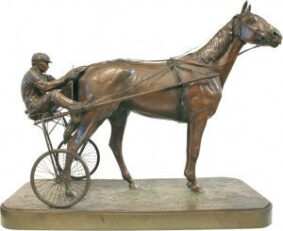
1912 was an incredible year for art, because this was the first time that it was officially recognized in the Olympic games. The summer games in Stockholm welcomed 33 artists as competitors, despite the initial quarrel between the IOC and the Swedes on whether or not art should be incorporated. Gold medals were awarded to artists in all five categories. One of the gold medalists includes an Italian artist named Carlo Giovanni Pellegrini, who won for his painting feature, “Three connected friezes representing Winter Sports.” Another extraordinary gold-medal worthy piece was sculpted by Walter Winan, a native Russian who represented the USA with his artwork titled, “An American Trotter.”
This integration of art into the Olympic games was just the beginning. Coubertin saw the promising future that awaited art in the games and advocated for them to be included during the summer of 1916 in Belgium. World War I curbed these efforts, and the games were cancelled. Defense for the evolution of art and its future in the Olympic games was held in a limbo. Fortunately, enough, 1920 Olympics revitalized art within a post-war setting, but were not well organized. Both the 1912 and 1920 Olympics paved the way for one of the most important Olympic games for artists, which was the summer of 1924 in Paris. This year would heighten the standards for all artistic submissions to be included into Olympic programs.
189 artists submitted their work for judging in 1924. Medals awarded included three gold, four silver, and six bronzes. Submission of artwork remained stable in 1928 during the Amsterdam summer games, regardless of the notable decline of sportsmen from 1924. A total of 1,150 artists were involved, and around 10,000 viewers attended the Municipal Museum of Amsterdam to view the pieces. The first real controversy surrounding art in the Olympics would arise in the summer of 1932 in Los Angeles, with the conflict being between the IOC and the artists themselves.
The contestants and their work drew in 384,000 visitors to the Los Angeles Museum of History, Science and Art for viewing. These games included the opportunity for artists to sell their work post-exhibition. The IOC opposed this due to an infringement upon the amateurism policy, which indicated that all Olympic contestants should be non-professional. If artists were profiting from their work, they could be considered professional. This did not become a major issue until 1949, when an official report was submitted to the IOC that exposed practically all competing artists as professionals. This directly violated the amateurism policy, and the arts formally saw their end in 1952.
In my personal opinion, the arts were an asset to the Olympics in the early twentieth century and could continue to be beneficial if they were reinstated in a formal way. The arts allowed for freedom of expression for a benefit of the artists’ entire community and country. In the contemporary scene, the arts are being swept by the wayside, and widespread support wanes. The Olympics should not entirely depend upon physical vigor and excellence to represent a country’s best qualities. Instead, the combination of artistic beauty and its integration into the form of sport should be valued alongside physical competitors.
