
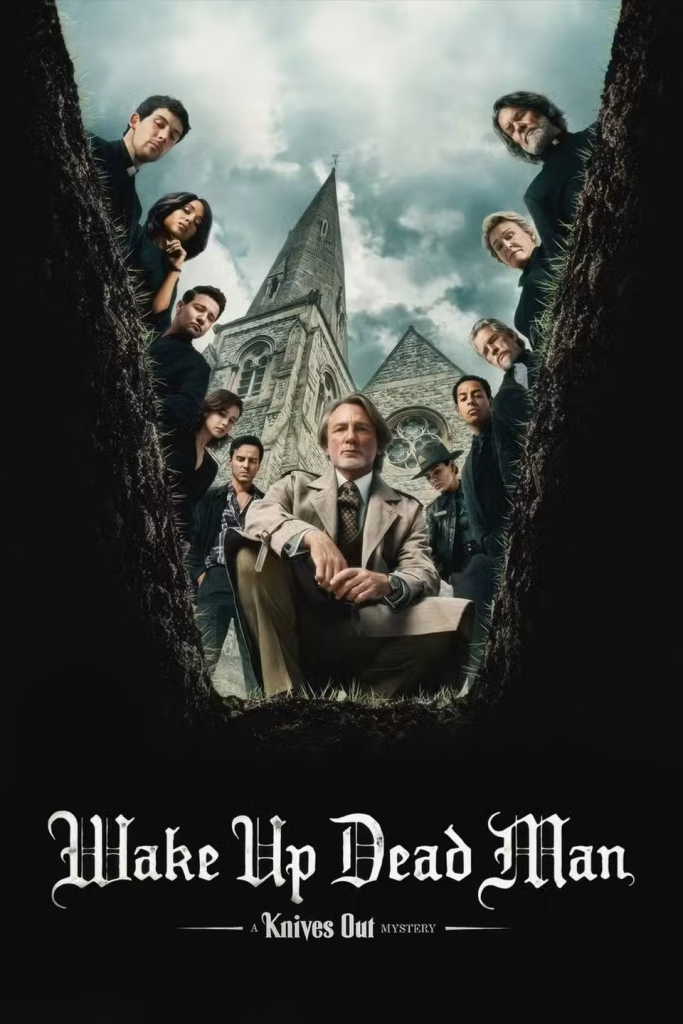
Ever since the first film released in 2019, I have considered myself a fan of Rian Johnson’s “Knives Out” movies. They fill the niche of Agatha Christie-style mysteries (a genre that feels all but abandoned in film) with their ensemble casts and compelling leading detective Benoit Blanc (played by Daniel Craig). The original film is excellent and although it tends to be more controversial among fans, I greatly enjoyed “Glass Onion”. I am also a Christian and take my faith quite seriously. So, when I heard that the next film, “Wake Up Dead Man: A Knives Out Mystery” would focus heavily on religious themes and iconography, I was both excited and anxious.
In my experience, the representation of Christianity in modern media tends to be quite poor. Christians are often portrayed as judgmental, hopelessly sentimental or just plain nasty. These types of Christians certainly do exist in the real world, yet those stereotypes have become a straw man in our cultural discourse. The very things that are used as criticisms of Christians are vestiges of Christian morality. So, how does “Wake Up Dead Man” fare in this regard?
The religious commentary in the latest “Knives Out” film is layered and complex but primarily focuses on the beliefs of three central characters: Blanc, Wicks, and Jud. Blanc is revealed to be an atheist who strongly dislikes Christianity. The murder victim, Monsignor Jefferson Wicks (played by Josh Brolin), is a mean, violent and thoroughly right-wing Catholic priest who fights the culture wars, scandalizes visitors and leads a cult-like inner circle of parishioners. He is juxtaposed with Rev. Jud Duplenticy (Josh O’Connor), a former boxer who murdered a man in the ring but found hope in Christ.
The film does perpetuate some of the frustrating straw-manning I mentioned earlier: Wicks and his parishioners are conservative Christians placed in an almost wholly unsympathetic light. Yet I find myself a little more willing to look past it in this case. For one, all the “Knives Out” films have used caricatured characters as comic relief and social commentary. For another, Fr. Jud’s character is so well realized and acted that I cannot help but applaud Johnson and O’Connor. He is kind and yet thoroughly non-romantic. As he tells Blanc, “God didn’t hide me or fix me. He loves me when I’m guilty,” a line that now lives rent-free in my head. He marries a deep sense of human depravity (especially his own) with hope in the work of Christ in a way that feels deeply refreshing. The tension between Blanc and Jud is easily the highlight of the film and there are some genuinely touching moments that I do not wish to spoil here.
Unfortunately, other aspects of the film do not fare so well. The plot is the weakest of the “Knives Out” trilogy. It has far too many “gotcha!” moments and twists, even compared to the previous films. The cast, with the notable exceptions of Craig, O’Connor and Brolin, feel woefully underutilized. As a murder mystery, it is the weakest of the trilogy.
“Wake Up Dead Man” is a film I have mixed feelings about yet cannot help but recommend. It, strangely enough, reminds me of “Barbie”. Both are films that do not resolve the questions their subject matter brings up, but act as fantastic jumping-off points for conversation. And frankly, our society could use more discourse, and that alone makes “Wake Up Dead Man” a valuable film.
