
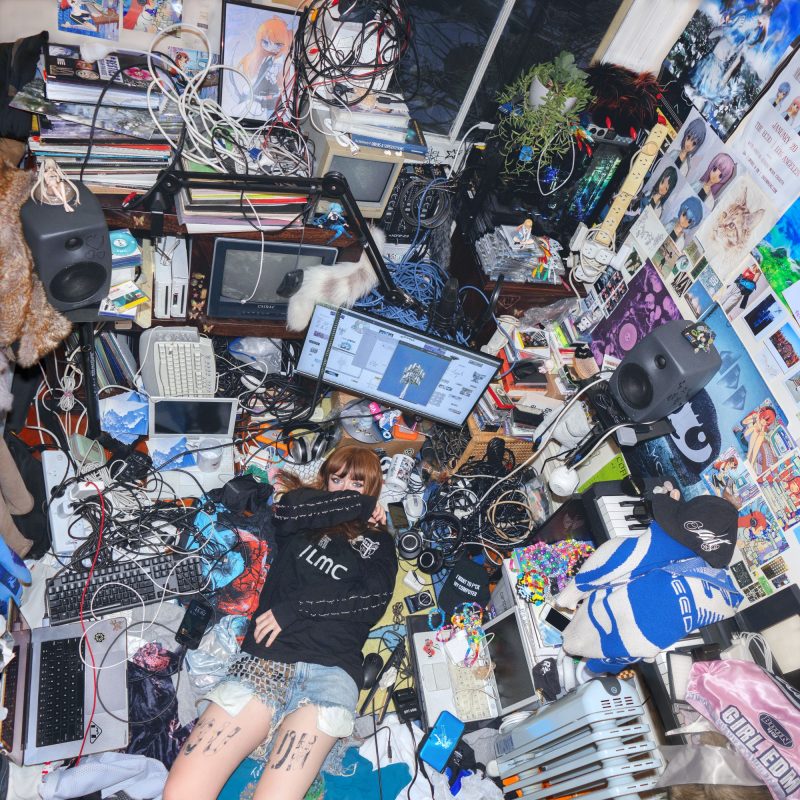
Just this past summer, artist Nina Wilson released “I Love my Computer” under the stage name Ninajirachi, a project which sparked her career through its mix of electronic pop sound and lyrics evoking a nostalgia for the early to mid 2010s. Winning several awards including ARIA’s Best Solo Artist and Best Breakout Artist of 2025, Wilson draws inspiration from her childhood love of dance and electronic music, coming to a realization that possibly the most crucial relationship she had growing up was one with her electronics. In practice, this love for her device’s manifests in a style Wilson self describes as “Girl EDM,” a mess of hyperpop beats and dance rhythms that blend together in a digital haze.
“I Love my Computer” comes across as a love letter to an era many listeners already will have an intimate connection with; tracks like “iPod Touch” and “CSIRAC” explore the whimsy and wonder of growing up in the age of new technology and social media. Instead of exploring her relationship through allusions to real people, Wilson directly confronts the nature of her relationship with memories from childhood. “iPod Touch” is possibly one of the best representations of Wilson’s style on this album, with lyrics about having her first access to the internet through a yellow iPod Touch, reminiscing on having to keep it “hidden underneath my pillow ‘cause I should be asleep” or the feeling of finding something cool and indie with likes like “I’ve got a song that nobody knows…and I heard it in a post when I was twelve years old”. As she sings on the song prior, “Anythin’ is possible with fingers, eyes, a mouse and a screen.” To her, the relationship she and many others have built with their devices is one of quiet fascination, something absurd to generations past but deeply integral to growing up and coming to age in her world. However, “Delete” is an acknowledgement of the awkwardness and confusion that comes with growing up, showing that even with the world at the tip of one’s fingers, anyone is subject to making mistakes, whether it be making a risqué post on social media or trying desperately to have the attention of others.
Maybe the most important aspect to this digital relationship is the dangers of being so connected. Parents can teach online safety and use parental features to block teens and children from seeing something they’re not ready for yet, but often something slips through the cracks as characterized in the track “Infohazard”. Using the concept of the info hazard, a piece of information which brings risk just through understanding or reasoning with it, Wilson describes the moment her bubble of online safety was breached by a graphic video and how she still sees parts of it in her dreams. Even despite this track, the vision of the album remains as a positive relationship, treating such events as just accidents that are bound to happen with any new connection.
With an understanding of just what makes up Wilson’s love for her computer, one cannot help but see the ways they have become intimate with their devices and the everyday relationships that stem from it. Whether it be texting a friend, taking notes for class or even doomscrolling on a Saturday morning, one would likely find it difficult to look at their phone or laptop and claim they don’t care for it to some capacity. Even the less social among us can see the ways something as small as an iPod or as integral as time in the computer lab have sculpted their experiences maturing into adulthood.
