
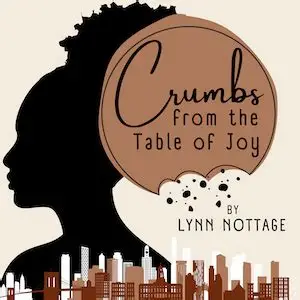
Eastern’s Theater Department is currently in the production process for their spring play, “Crumbs from the Table of Joy.” It features students Amari Dickerson as Godfrey Crump, Catherine Smith as Lily Anne Green, Abigail McNair as Ermina Crump, Jordyn Wortham as Ernestine Crump and Zaida Harper as Gerte Shulte.
Set in 1950s New York City, it centers the story around an African American family coming from Florida in the second wave of the Great Migration, looking for a haven from discrimination and more opportunity up North. The mother of the family has recently passed away, the father (Dickerson) and the rest of the family deal with this grief as they navigate unfamiliar territory. To complicate matters, the father has recently become captivated by a spiritual leader who was a real historical figure in Philadelphia: Father Divine. His new religious journey clashes with a nonreligious wacky aunt (Smith) who is viewed as a communist, all while two teenage daughters (McNair and Wortham) wrestle with what it means to grow up. The father then falls in love with a white woman (Harper), a taboo in 1950s America, even in the North.
Valerie Flower, the chair of the theater department, says the choice of show was intentional in part for the identity of the playwright. “We definitely wanted to do a play by a female identifying playwright, because we have done mostly plays written by men, and we have not had a whole lot of diversity,” Flower said.
Another crucial reason was the consistent themes of justice explored throughout the show. “We wanted to plug into [Eastern’s] mission of justice in particular. The faith and the reason portion have been really evident in a lot of what we’ve done, but the justice piece in theater was something we wanted to connect with. We looked at a lot of different plays and there were many good options, but this particular one addresses issues we’re dealing with right now, in terms of social justice, particularly some civil rights issues,” Flower said.
Although the show tackles relevant issues like immigration, addiction, assimilation and racial injustice, it deals with it from the perspective of the 1950s. “It’s got a whole host of very resonant themes, but to be distanced by this many decades from that period, it allows us to kind of enter that world in a way that’s a little less raw,” Flower said.
Flower is not directing the show this spring – instead, it will be guest directed by Taahira Teshi, a recent Villanova MA theater graduate who is directing a show in a university setting for the first time. Flower wanted a guest director who was relatively new in their theater career, a hard world to break into. “I personally was looking for someone who was early in their career to kind of help give just the opportunity. Certainly, the opportunity to mentor is important, but I just wanted to give her the space and the time and the students to have a chance to direct a fully mounted play and have all of the support of a faculty and staff… it’s rare that you get those opportunities early in your career. When we met with her, we were just really excited to give her the chance to bring all of her new ideas, her newly mined degree and her enthusiasm to this piece,” Flower said.
As an actress herself, Teshi is most excited for audiences to see the talented actors in action. “I’m excited to see what these actors do with this material. I’ve already seen a little bit of it at auditions and callbacks, and that helped me formulate my vision for the show. This is a very heavy show, and it deals with a lot of different topics, but I feel like they’re a great group of kids that will be able to really bring some life and fun and humor, but then also vulnerability to this wonderful piece of work.”
Even though the show is set in the 1950s, Teshi says audiences will be able to relate to the themes in 2026. Whether it’s walking through grief, wrestling with faith and religion, the turbulence of adolescence, the wackiness of family or the hefty weight of racism and discrimination, everyone can relate to these timeless themes. “This show has something for everybody.”
Although it’s still early in the production process, Teshi sees a vision for how she wants to emphasize the themes explored throughout the show. “As a director, I really want to bring the realism and humanity to all of these themes and explore them in very honest ways.”
A particular theme that Teshi emphasized is the coming-of-age nature of the main character. The character has to listen to a variety of clashing voices and choose which ones she wants to internalize into her own identity. “[It’s about] kind of figuring out your own identity and where you belong and where you fit. How much of what your family says are you going to take to heart and how much are you going to craft your own identity from yourself? What do you pick up from your environment and what do you pick up for your own benefit?” It’s a theme and a story that has been told as long as children have been growing into adults, and the show explores this theme alongside the complexities of the historical moment.
Teshi also wishes to emphasize the role that hope plays in the face of adversity. “Every character has little ‘crumbs’ of happiness and joy they cling to in difficult times and in a world that is often unfair and cruel. But I believe that it’s important to keep hope alive even when life seems hopeless. I have my own motto of always looking on the brighter side of life, which was inspired by the song by Monty Python. I choose to focus on good things, rather than dwell on the negative even when there’s so much negativity around me,” she said.
“Crumbs From the Table of Joy” premiers at Eastern in March, come out to support fellow students and guest director Taahira Teshi!
