
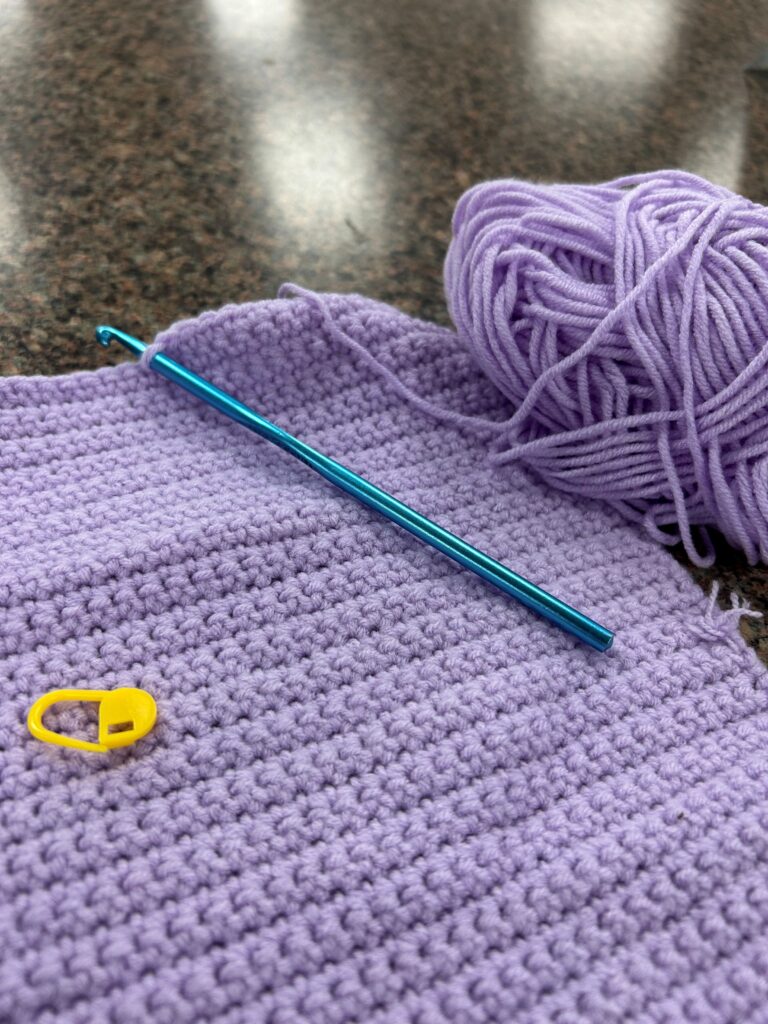
There are many things that one can crochet, but for something hopefully simple and relatively practical, this is a guide to crocheting a washcloth or dish cloth. All that is needed is yarn, a crochet hook, your hands, and most importantly, your last ounce patience! It is recommended to start with a thicker sized yarn if you are a beginner as it is easier to grab with the hook. For example, if you have a bulky sized yarn, the suggested hook size would be between 5.5 mm and 9 mm. The texture and color of the yarn can be whatever you like. If these measurements do not match the materials you have, work with what is accessible or most comfortable. For fundamentals, the shorter side or beginning of the yarn will be referred to as “the tail” and the longer side that leads to the ball of yarn will be referred to as “the working yarn.”
Our first big step is to make what is called a slip knot. Find the tail of your yarn and make a line that’s about five inches on a flat surface. Have the tail on the right side and the working yarn on the left.
Then pick up the tail and move it clockwise and lay it over top of the working yarn. This should create a loop shape.
With the project still laid flat, pick up the end of the loop (the side opposite to the point of intersection) and flip it over top of the working yarn.
This should now look like a circle with a line in the middle. Pick up the yarn in the middle of the circle. With another hand, hold onto the tail.
Pull gently on both sides of the yarn until there is a knot formed at the bottom of a loop.
Then place your crochet hook inside that loop. Then, pull the working yarn to tighten the yarn around the hook.
Make sure the loop is not too tight around the hook. This makes it harder to be crocheted into. If needed, pull both sides to loosen the loop.
Congratulations, you have made a slip knot (hopefully)!
There are multiple ways to hold the hook and yarn, so play around and find what is most comfortable. Ideally, the crochet hook would be held with your dominant hand and the working yarn in your opposite hand. Be careful not to let the slip knot slide off the hook.
A suggested way to hold the project is to hold the hook with your dominant hand.
With your other hand, place the working yarn in between your middle and pointer finger.
Then, pull the side attached to the hook towards you and let it hand over your pointer finger.
Be careful not to hold the yarn too loosely as it can make crocheting harder and the stitches uneven. For extra grip, the working yarn can be weaved in between your other fingers.
Lastly, hold the knot from the slip knot with your thumb and pointer finger.
At this point, hopefully you find yourself in a comfortable position. Now, the creation of the first chain can begin. The chain is the foundation that determines how long the project ideally will be.
To begin the chain, allow the slip knot to have some space from the top of the crochet hook.
Then, wrap the yarn, from back to front, around your hook once. The yarn now wrapped around can sit underneath the actual hook to make it easier to pull.
With the hook faced down and the yarn underneath the hook, pull the hook and yarn through the first loop wrapped around the hook towards you. This creates a chain stitch.
Wrap the yarn around the hook again and pull through the previous loop. This has made two stitches.
To make a reasonable size for the washcloth, this step would need to be repeated to make 40 chains. Repeat this step until you reach 40 stitches or have the size you would like. 40 stitches will make the chain almost 13 inches. This requires a lot of patience!
Once you have reached your desired length, the beginning of a single crochet stitch can be made.
Insert your hook from back to front through the center of the second chain away from the hook.
Wrap the working yarn around the hook from front to back and pull through the chain. There should now be two wraps of yarn around the hook.
Now, wrap the working yarn around the hook again and pull it through both wraps of yarn. An edge should be starting to form.
Insert the hook into the next stitch. Then, wrap the working yarn around the hook and pull through the stitch.
Wrap the yarn around the hook again and pull through both wraps of yarn. This has made two single crochet chains.
Repeat this step until you have reached the end of the chain. To count how many stitches have been made, look at the top of the project and count the V like shapes.
Once the end of the chain has been reached, make sure every stitch has been crocheted into. Now you will need to create the “turning chain.”
Wrap the yarn around the hook and pull through the loop on your hook.
Then flip the project over to work from right to left. The next row will be created by crocheting into the top of the stitches from the previous row.
Insert your hook into the first hole underneath the V at the top of the stitch. Be sure to always go into the first stitch of the row to ensure that the sides will be even.
Wrap the yarn around the hook and pull through the loop around your hook.
Creating two wraps around the hook, wrap your yarn around the hook again.
Pull through both wraps around the hook. This completes another single crochet stitch.
Continue this pattern until you reach the end of the chain. Then create another “turning chain.”
The project can be completed by continuing the process until you have reached 13 inches or your desired length on each side (13×13). If you have made the project the size either recommended or guided, now you can tighten the ends to keep the project from unraveling.
To do this, make sure each stitch has been crocheted into. With your hook still in, cut your yarn, but leave a tail of at least four inches.
Then, wrap your yarn around your hook and pull the yarn completely through the loop, making a knot. Pull the knot tight.
Many crocheters take the excess yarn and weave it back into the project using a tapestry needle, but this is not the most necessary thing. If anything, the yarn can be cut shorter.
If you have made it this far, you have a lot to be proud of! If not, be proud of yourself for trying! Crocheting can be a very frustrating process and takes a good amount of time. Please be willing to keep trying and take breaks when needed.
