
Art plays a unique role in stilling the mind and offering a different sort of mental healing. The effectiveness of art therapy and studies about art and mental health demonstrate that art has positive effects; but what exactly are the benefits of art on mental health?
Many people do art as a hobby, a form of relaxation. Art provides a respite from mental activity and stress. Making art does not require the same cognitive functions as studying or writing an essay. Instead, art engages the hands and eyes (painting, knitting or playing an instrument) or the voice and ears (music) or the whole body (dance).
There are many students at Eastern who relax through art. Emma Nakhla, a junior at Eastern, described the benefits of drawing and crafting as a way to de-stress. She mentioned that she doodles whenever she feels the “need to do sometimes with [her] hands.” According to Nakhla, working with your hands can be a way to ground yourself. She voiced, “I feel more at peace, because it gives me something to focus on at that moment.”
This particular attention and focus that comes with art is a significant reason why art improves mental health. Art requires an attention to detail in which we do not usually indulge. For example, Alice Van Eman, a dance minor, explained how dance can be a way of paying closer attention to your body. She described a liturgical dance workshop that she led which guided the participants in paying special attention to the parts of their body that were under stress. “I had everyone start on the ground, and do an intake of your body: areas that were tense, injured recently, hurting. Then I had them place their hand wherever that place was… acknowledging that area that was not feeling well, giving it attention.” The participants then started their dance from that hurting body part, allowing the previously neglected part of the body to lead the dance.
This sort of close attention is baked into all forms of art. You cannot dance well without taking special care of your body. Similarly, you cannot draw or paint well without careful observation of your subject matter. Hannah Choi, a biology student who sketches in her free time, talked about how when she draws she is “focused on where [she is] and the details [of what she is drawing] – and that helps [her] relax.” The focus on details she would usually overlook drew Choi outside of herself in a way that relaxed her. She felt grounded. Van Eman took particular care of the stress in her body by paying attention to it, while Choi de-stressed by turning her attention outside of herself. Art can offer both benefits; introspection and outward appreciation of beauty.
Van Eman reflected that art helps an individual tap into their emotions on a different level than the verbal articulation of “how I feel.” She explained that “the body remembers things that we might not think of cognitively. Sometimes ‘you can understand your emotions through your body’ better than you can understand through words.” All art, not just dance, allows the artist to explore their emotions through the senses and embodiment. As Van Eman put it, art is “exploring that feeling in a different way – a nonverbal way.”
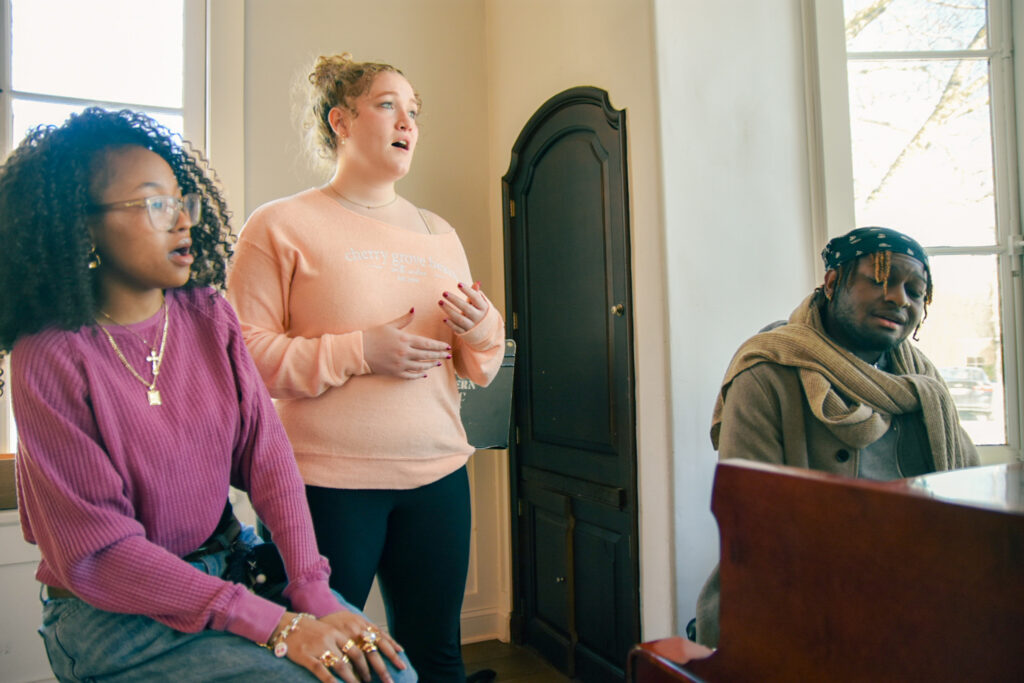
Art builds connection as well as meaning. Ethan Muldoon, a student who sings in multiple groups, from a small band to his church choir, explained that in the band with his friends “we’re exploring an idea together, building off of each other, communicating in that way – sharing that experience.” In his church choir, too, the experience becomes communal through the “atmosphere of reverence” which the music creates.
Nakhla also talked about the simultaneous connection and nonverbal meaning behind art. She described a calendar she made and decorated as a gift for her boyfriend, explaining that her goal with the calendar was “not just about how it looked but also the meaning.” The calendar, hand-decorated with pictures of the two of them, was not just pretty to look at, but also embodied the importance of their relationship. Art is not just about the product, but also the process; not just what it looks like, but what it communicates and means.
In fact, art is not just about the artist, but also about the audience. Art can heal not only the person making art, but also the people appreciating that art. Van Eman said that “even audience members can participate in the dance by being open” – open to the emotion dance evokes and open to allowing the movement of dance to enter their own bodies.
Muldoon described art as a “nonverbal way of opening up.” In art, you can be (in Van Eman’s words) “vulnerable, putting a name [with your art]… to something you can’t say in words.” Whether you are making art or just watching art, you can open your mind to the nonverbal restful healing that comes with creativity.
